


Chilled red wine: which to serve, how cold, and why
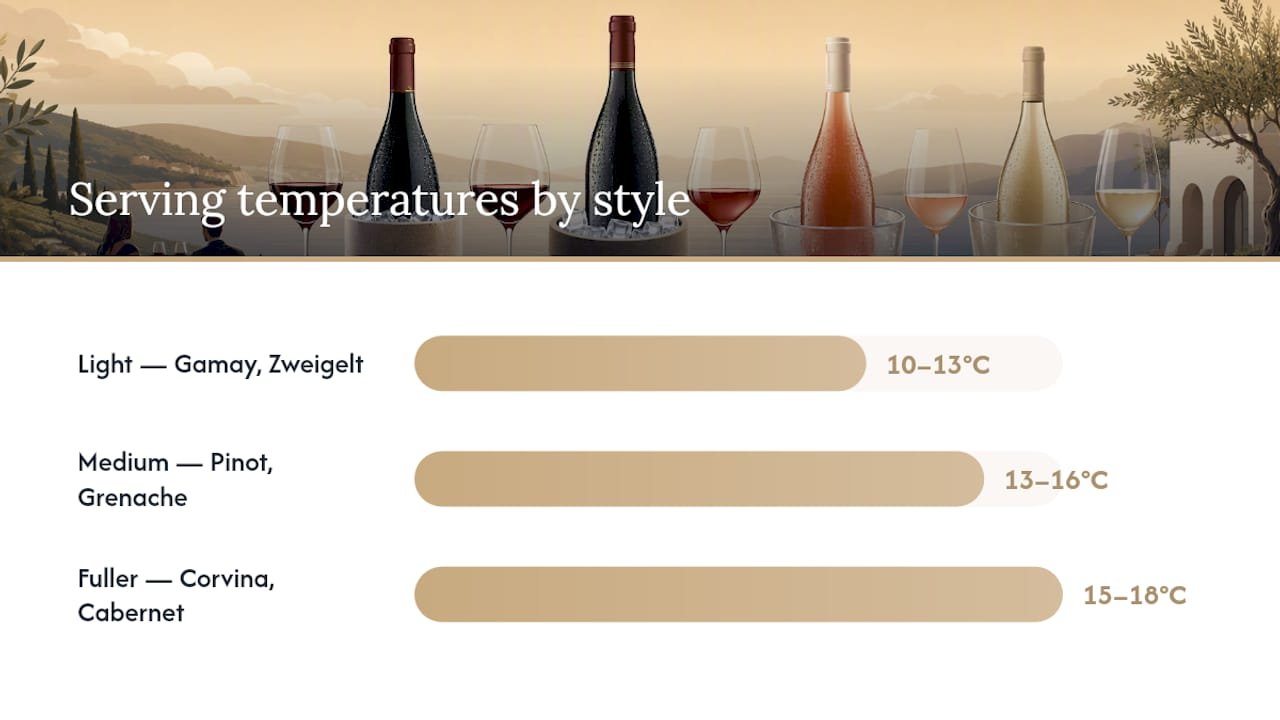
Light, fruity reds such as Gamay (Beaujolais), cool-climate Pinot Noir, Grenache, Cinsault, Corvina (Valpolicella), Mencía, Frappato, Zweigelt, and lighter Loire Cabernet Franc examples all benefit from a short chill before serving. The Court of Master Sommeliers service standards set the target bands clearly: light reds at 10–13°C, medium-bodied reds at 13–16°C, and fuller or aged reds at 15–18°C. Drop below 10°C and you risk muting the aromatics and making tannins taste harsh and bitter.
Three quick ways to chill red wine:
- Fridge: place the bottle in the fridge for a moderate amount of time before serving
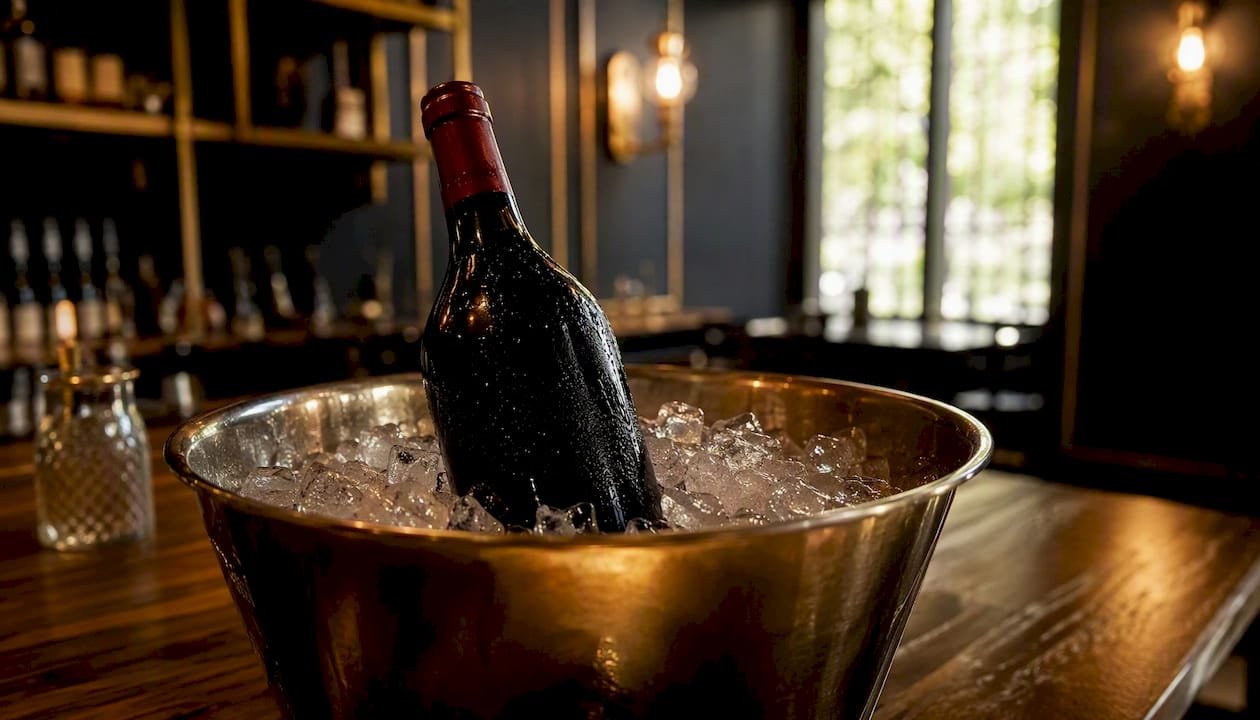
- Ice bath: submerge the bottle in a mixture of ice and cold water for a shorter duration
- Short fridge blast: a brief fridge rest can bring a warm bottle into a more pleasant range without over-chilling
The bottle should feel cool to the touch when you pour, not cold enough to numb your hand.
| Style | Typical serving temperature range | Typical varieties |
|---|---|---|
| Light red | Cooler serving temperature | Gamay, Frappato, Zweigelt |
| Medium-bodied red | Moderate cool serving temperature | Pinot Noir, Grenache, Mencía, Cinsault |
| Fuller/aged red | Warmer serving temperature | Cabernet Franc (fuller Loire), Corvina blends |
| Avoid chilling | Very cold temperatures are not recommended | Any style — as this can mute aroma and sharpen bitterness |
Key takeaways
Light, low-tannin reds such as Gamay, Frappato, and Zweigelt are the most reliable choices for chilling, with a target temperature of 10–13°C for the lightest styles and 13–16°C for medium-bodied reds.
| Point | Details |
|---|---|
| Best grapes to chill | Gamay, Frappato, Zweigelt, Cinsault, Mencía, light Pinot Noir, and young Loire Cabernet Franc. |
| Target temperatures | Light reds: 10–13°C; medium-bodied: 13–16°C; fuller/aged: 15–18°C; never below 10°C. |
| Fastest safe method | Ice bath (equal parts ice and water) reaches serving temperature in 10–30 minutes; avoid the freezer. |
| What to avoid chilling | Aged bottles, high-tannin reds (young Cabernet, Aglianico), and heavily oaked wines. |
| Lost And Found Taproom | Stocks fridge-ready reds in summer — check the online menu or ask staff for the current chilled selection. |
Table of Contents
- Which red wines work best chilled, and why?
- What makes a red wine chillable? A practical checklist
- How to chill red wine properly: timing and method
- Which reds should you not chill?
- Food pairings and occasions that suit chilled reds
- Styles and bottles worth trying in the UK
- What sommeliers say, and why “room temperature” misleads you
- A local host’s note on chilled reds at Lost And Found
- Taste chilled reds at Lost And Found Taproom
- Sources
Which red wines work best chilled, and why?
The short answer is: reds with low-to-moderate tannins, bright natural acidity, and minimal oak contact. Those three traits mean chilling sharpens the fruit rather than hardening the structure. Good Housekeeping’s senior wine buyer Will Hill puts it plainly: lighter-bodied reds lack the aggressive tannins that turn bitter when cold, which is precisely what makes them ideal candidates.
Gamay and Beaujolais
Gamay is the grape most people picture when they hear “chilled red.” Beaujolais Villages and cru Beaujolais (Fleurie, Morgon, Brouilly) are juicy, low-tannin, and packed with red cherry and violet notes that sing at 10–12°C. Beaujolais Nouveau is the most accessible entry point and is widely stocked in UK supermarkets from November onwards, though cru bottles are the more interesting long-term choice.
Pinot Noir (cool-climate styles)
Not every Pinot Noir belongs in the fridge. Cool-climate examples from Burgundy, Alsace, or English producers tend to be lighter, more acidic, and lower in alcohol — those are the ones that reward a 20-minute fridge rest. Aim for 13–15°C.
Grenache and Cinsault blends
Southern French and Spanish Grenache can be surprisingly light when made in a fresh, low-intervention style. Cinsault, often blended with Grenache in Languedoc or South African rosé-adjacent reds, is almost always low-tannin and high-acid. A Grenache-Cinsault blend at 12°C with a plate of charcuterie is a genuinely underrated summer combination. Look for bottles from the Languedoc, Costières de Nîmes, or South Africa’s Swartland region.
Corvina and Valpolicella
Valpolicella Classico (not Amarone, not Ripasso) is made primarily from Corvina and sits at the lighter end of Italian reds. Served at around 13°C, it shows tart cherry, dried herbs, and a pleasant bitterness that works well with tomato-based dishes. UK supermarkets and Italian specialists stock it reliably.
Mencía
Spain’s Mencía, grown mainly in Bierzo and Ribeira Sacra, produces wines with dark fruit, floral notes, and firm but not aggressive tannins. At 13–15°C it becomes more aromatic and food-friendly. Increasingly available in UK independent merchants and online retailers. For a broader look at where Mencía sits on the body and tannin scale, this grape variety guide is a useful reference.
Frappato
Sicily’s Frappato is one of the most naturally chill-friendly reds in existence: pale, almost translucent, with strawberry and rose-petal aromatics and very low tannins. Serve it at 10–12°C and it reads almost like a serious rosé. Specialist Italian merchants and a growing number of independent bottle shops in the UK carry it.
Zweigelt
Austria’s most widely planted red grape produces wines that are light, cherry-scented, and low in tannin. Zweigelt at 11–13°C is a crowd-pleaser at summer gatherings and is increasingly appearing in UK wine merchants and online retailers as Austrian wine gains traction.
Lighter Loire Cabernet Franc
Chinon, Bourgueil, and Saumur-Champigny made from Cabernet Franc in the Loire Valley can be surprisingly delicate: pencil shavings, red pepper, and fresh raspberry, with moderate tannins. The lighter, younger examples (avoid anything described as “reserve” or “vieilles vignes” for chilling purposes) work well at 13–15°C. These are stocked in most UK specialist wine merchants and some supermarkets.
UK availability at a glance: Beaujolais and Valpolicella are the easiest to find in major supermarkets. Mencía, Frappato, and Zweigelt are more reliably found at independent bottle shops, specialist merchants such as Berry Bros & Rudd or Majestic, and online retailers. Local taprooms and wine bars with a rotating selection, like Lost And Found Taproom in Brighton’s Fiveways, often carry fridge-ready bottles that you won’t find on a supermarket shelf.
What makes a red wine chillable? A practical checklist
Before you reach for a bottle, run through these cues quickly. No single factor is definitive, but three or more ticks and you’re almost certainly safe to chill.
- Lower alcohol by volume generally signals a lighter style; higher alcohol reds tend to have more body and oak
- Paler or translucent colour can indicate suitability for chilling
- Labels without mention of oak ageing, or indicating “unoaked” style, tend to be better chilled
- Younger vintages often suit chilling better than aged wines, which develop complexity
- Light body and bright acidity as described in tasting notes can suggest chilling suitability
- Some producers explicitly recommend serving chilled on the label
- Certain grape varieties such as Gamay, Frappato, Zweigelt, Cinsault, and young Mencía are commonly suitable for chilling
Pro Tip: Chillability is as much about winemaking style as grape variety. A Grenache made with whole-cluster fermentation and no oak in the Languedoc can be perfect at 12°C, while a Grenache from a hot-climate producer aged in new oak will taste flat and bitter at the same temperature. When in doubt, check the producer’s own website or ask your bottle shop.
How to chill red wine properly: timing and method
Getting the temperature right is less complicated than it sounds. The goal is to reach the target band without shocking the wine or leaving it in the fridge so long it becomes a tannin-sharpening exercise.
Step-by-step methods
-
Fridge method (most reliable): Place the bottle upright in the fridge. For a light red targeting 10–13°C, allow 45 minutes to an hour from room temperature. For a medium-bodied red targeting 13–16°C, 20–30 minutes is usually enough. BCfW’s practical guide to chilling reds confirms the 45-minute-to-one-hour window for a full chill.
-
Ice bath (fastest reliable method): Fill a bucket or large bowl with equal parts ice and cold water. Submerge the bottle up to the neck. A light red reaches serving temperature in roughly 10–20 minutes; a medium-bodied red in 15–30 minutes. The water conducts cold far more efficiently than air, which is why this beats the fridge for speed.
-
Short fridge blast: If you only have 10–20 minutes, a brief fridge rest will bring a warm bottle into a noticeably more pleasant range without taking it all the way down. Not perfect, but better than serving at 22°C.
-
Cellar or cool larder: If you have a cellar or a genuinely cool room (around 13–15°C), storing your lighter reds there means they’re always close to serving temperature without any active chilling needed.
| Method | Approximate time to reach cooler serving temperature | Approximate time to reach moderate serving temperature | Notes |
|---|---|---|---|
| Fridge | Up to an hour | Less than an hour | Most consistent method; timing depends on conditions |
| Ice bath | About 10 to 20 minutes | About 15 to 20 minutes | Fastest practical method |
| Short fridge blast | Less than 20 minutes | Less than 15 minutes | Offers quick improvement in temperature |
| Cool larder/cellar | Temperatures already ideal | Temperatures already ideal | Best for storing bottles at serving temperature |
One firm caution: avoid the freezer. Rapid freezing stresses the wine, risks tartrate crystal precipitation, and can affect the aromatic profile. BCfW’s guide specifically discourages freezer rapid-chill for this reason. An ice bath is faster than most people expect and far gentler.
A note on tartrates: if you chill a red too aggressively and see small crystal deposits in the glass or bottle, those are harmless tartrate crystals. They don’t affect flavour, but they’re a sign the wine got colder than intended.
Which reds should you not chill?
Some wines genuinely suffer when cold, and knowing which ones saves you from a disappointing glass.
- Aged or complex bottles — a ten-year-old Barolo or a mature Bordeaux has secondary aromas (leather, earth, dried fruit, tobacco) that close up when chilled; you lose the very thing you paid for
- High-tannin young reds — young Cabernet Sauvignon, big Shiraz/Syrah, Aglianico, and Nebbiolo have tannins that cold temperatures make taste harsh and drying
- Heavily oaked reds — oak-derived vanilla and spice notes become muted and the structure feels disjointed when cold
- High-ABV reds (above 14.5%) — the alcohol doesn’t disappear; it just becomes more obvious as other elements close down
Cold temperatures accentuate bitterness and suppress aromatic complexity. For a wine built around secondary notes and structured tannins, chilling is not a neutral act — it actively works against what the winemaker intended. The Donzella Wines explainer on chilling red wine makes this point well: a slight chill sharpens acidity and reduces perceived alcohol heat, which is a benefit for light reds but a liability for wines where those elements are already in careful balance.
One exception worth noting: on a very hot day, even a full-bodied red can benefit from a brief 10-minute fridge rest before serving. The goal isn’t to chill it properly — it’s to stop it arriving in the glass already at 24°C and warming further. A light chill buys time.
Food pairings and occasions that suit chilled reds
A chilled red occupies a useful middle ground: more structure and depth than most rosés, more refreshing than a room-temperature red. That makes it genuinely versatile at the table.
Pairings that work particularly well:
- Salads and goat’s cheese — the acidity in a chilled Gamay or Frappato cuts through creamy cheese and complements dressed leaves
- Grilled white meats — chicken thighs, pork tenderloin, and turkey all pair naturally with a cool, fruit-forward red
- Cold cuts and charcuterie — a chilled Cinsault or Mencía alongside cured meats is a classic French and Spanish apéritif move
- Tomato-based pizzas — Valpolicella Classico at 13°C with a margherita is one of those combinations that just works
- Spicy food — a slight chill sharpens acidity and reduces the perception of alcohol heat, which helps balance heat from chilli or spice
- Picnic and apéritif settings — a chilled red travels well, needs no decanting, and pleases a wider range of palates than a room-temperature red
Occasions: alfresco summer evenings are the obvious fit, but chilled reds also work at casual lunches, barbecues where you want something more interesting than rosé, and apéritif service before a meal. They’re the wine equivalent of a light linen shirt: appropriate for more situations than you’d initially think.
On glassware: a smaller-bowled glass (a standard Burgundy or universal glass rather than a large Bordeaux bowl) helps. The wine warms slightly as you hold the glass, which gradually opens the aromatics. Pour smaller amounts more frequently rather than filling the glass, and you’ll get the best of both the cool and the open.
Pro Tip: Serve chilled reds slightly cooler than you think you need to. They warm up in the glass within minutes, especially outdoors. Starting at 10–11°C means you’re drinking at 13–14°C by the time you’re halfway through the glass.
Styles and bottles worth trying in the UK
The UK market for chillable reds has grown noticeably. The Times has covered the category as a summer staple, and retailers are increasingly using “chill-to-reveal” labels that change colour when the bottle reaches the right temperature. That’s a practical innovation for anyone who doesn’t own a wine thermometer.
- Beaujolais/Gamay: Fleurie or Brouilly from a reliable producer. Widely available at Waitrose, Majestic, and independent merchants. Expect red cherry, violet, and a silky finish at 11°C.
- Valpolicella Classico: Look for “Classico” on the label (not Ripasso or Amarone). Tart cherry, herbs, and a pleasant bitter finish. Supermarkets and Italian specialists carry it.
- Light Pinot Noir: Burgundy village wines or English Pinot Noir. Majestic, Berry Bros & Rudd, and specialist online merchants are the best sources. Strawberry, earth, and fine tannins at 13–14°C.
- Grenache/Cinsault blends: Languedoc or South African examples. Independent bottle shops and online retailers are the most reliable channel.
- Mencía: Bierzo or Ribeira Sacra. Increasingly stocked by independent merchants and online retailers. Dark fruit, floral, and mineral at 13–15°C.
- Frappato: Sicilian, pale, and aromatic. Specialist Italian merchants and independent bottle shops. Strawberry, rose petal, and very low tannins at 10–12°C.
- Zweigelt: Austrian, cherry-scented, and easy-drinking. Growing availability at UK wine merchants and online. Works at 11–13°C.
- Loire Cabernet Franc (Chinon, Bourgueil): Young, lighter examples from specialist merchants and some supermarkets. Red pepper, raspberry, and fresh herbs at 13–15°C.
When shopping, ask your local bottle shop for bottles tagged “chillable” or “fridge-ready” — many independent shops now use this shorthand. Check the back label for a serving temperature suggestion; producers who recommend chilling usually say so explicitly. The 2026 premium wine trends analysis from FU Wine notes that chillable styles are among the fastest-growing categories in both retail and hospitality, so availability is only improving.
What sommeliers say, and why “room temperature” misleads you
The “room temperature” rule for red wine is one of the most persistently misapplied pieces of wine advice in circulation. Riedel’s temperature guide traces the origin clearly: the instruction referred to pre-central-heating cellar temperatures of roughly 13–18°C, not a modern living room sitting at 20–22°C. Serving a light red at 21°C is not “room temperature” in any historically meaningful sense — it’s warm, and it makes the wine taste flat and alcoholic.
Myth-busting:
- “Chilling ruins red wine” — false for light, low-tannin styles. It sharpens acidity, reduces perceived alcohol heat, and makes the wine more refreshing. The risk is over-chilling, not chilling itself.
- “Room temperature is always correct” — only if your room is a medieval cellar. Modern homes are 5–8°C warmer than the historic cellar conditions the rule described.
- “You need a thermometer” — useful but not essential. A bottle that feels cool to the touch (not cold) is usually in the right zone. Trust your hand before you trust a rigid rule.
Ageing and oak change the calculation significantly. A wine with complex secondary aromas built over years in barrel and bottle needs those aromas to be accessible — cold suppresses them. A young, fruit-forward Gamay has no such complexity to lose, so chilling only helps.
Pro Tip: When a producer explicitly recommends chilling on the label, take them at their word. They know the wine better than any general rule does.
A local host’s note on chilled reds at Lost And Found
At Lost And Found Taproom in Brighton’s Fiveways, we rotate lighter, fridge-ready reds onto the by-the-glass list through the warmer months. The logic is simple: a chilled Gamay or a cool Frappato served alongside a street-food collaboration dish is a better match for a sunny afternoon than a room-temperature Malbec.
When you order a glass, the staff will tell you what’s currently chilled and what pairs well with whatever the street-food partner is serving that day. If you’re buying a bottle to take home, ask at the bar — we keep a small selection in a chilled unit for immediate service, and the full list of what’s available is on our online menu. For anyone curious about how temperature affects drinks more broadly, our beer serving temperature guide covers the same logic applied to craft beer styles.
The short version: come in, try something cold and red, and see whether it changes your assumptions. It usually does.
Taste chilled reds at Lost And Found Taproom
Lost And Found Taproom is Brighton’s independent answer to the question of where to actually try a chilled red rather than just read about one. The curated wine selection sits alongside a rotating craft beer list, and in summer the focus shifts to lighter, fridge-ready bottles that work with the food being served that day.

You can check the current wine and food offering on the menu page before you visit — everything is listed online, including what’s available to take away. If you want to pick up a bottle to chill at home, the team can advise on what’s in stock and what to pair it with. Lost And Found Taproom is at Fiveways, Brighton. Opening times and contact details are on the website. No reservation needed for a glass; for a private event or venue hire, the venue hire page has the details.
Sources
- Service standards (Court of Master Sommeliers)
- Good Housekeeping — Best chilled red wine (Will Hill / buyer commentary)
- BCfW — Your essential guide to chilling red wines
- Riedel — the perfect temperature for your wine
- The Times — best red wines to serve chilled
- Donzella Wines — Should red wine be chilled? Explained