



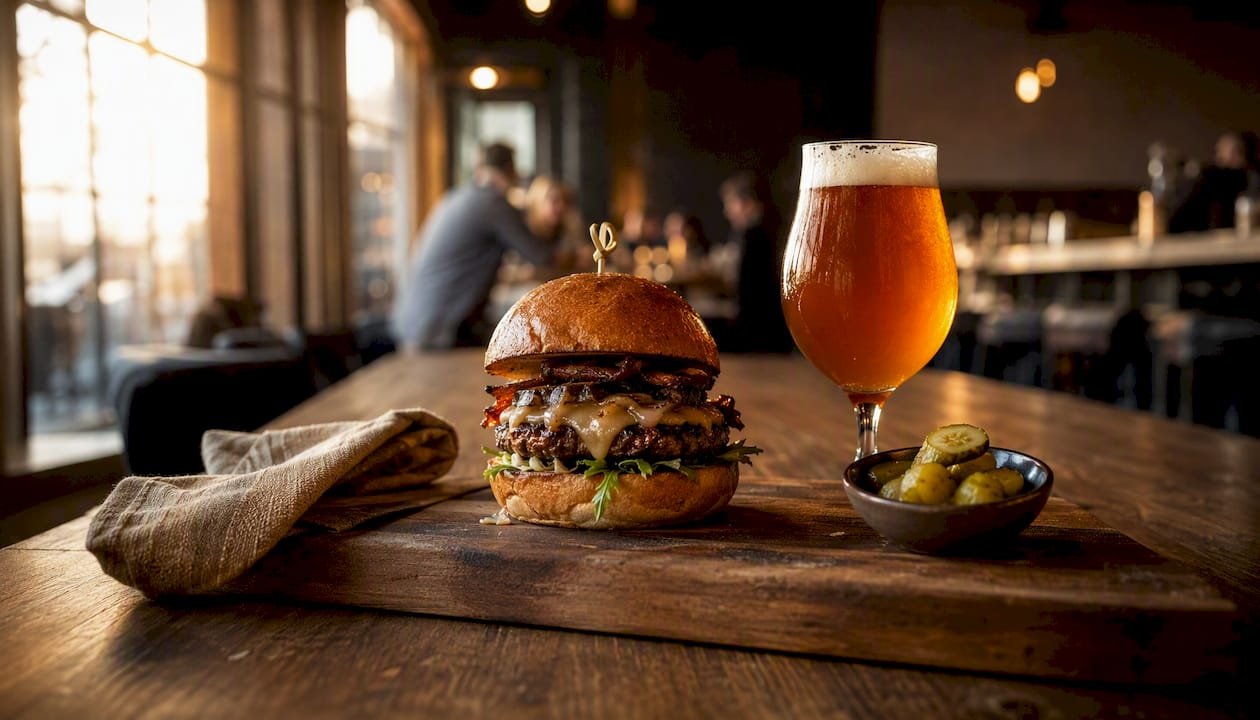
Beer and burger pairing: quick matches for enthusiasts
Match burger intensity to beer intensity. That single rule covers most situations: a light chicken burger wants a crisp pilsner or Hefeweizen; a fat-laden BBQ bacon beast needs a malty amber or a bitter IPA to cut through it. These are beer styles, not brands, so you can apply them anywhere from a backyard barbecue to a pub menu. Lost And Found Taproom carries a rotating selection of local and UK-wide styles, so you can test these matches in person.
Quick cheat list:
- Classic beef burger → crisp lager (cut/contrast)
- Cheeseburger → amber ale (complement)
- Bacon and BBQ burger → smoked porter or brown ale (complement)
- Lamb burger → session IPA or pale ale (contrast)
- Fried chicken burger → Hefeweizen or pilsner (cut)
- Turkey burger → golden ale or saison (complement)
- Venison or game burger → robust porter or red ale (complement)
- Veggie or vegan burger → fruity pale ale or sour (contrast)
Key takeaways
The single most reliable rule in beer and burger pairing is this: match the intensity of the beer to the intensity of the burger, then choose complement, contrast, or cut based on the dominant flavour challenge.
| Point | Details |
|---|---|
| Intensity matching | Light burgers need light beers; bold, fatty burgers need malty or bitter styles with body. |
| Use cut for fat | High carbonation and bitterness scrub fat from the palate; choose a pilsner or IPA for rich, saucy burgers. |
| Toppings drive the choice | Blue cheese, pickles, and BBQ sauce often matter more than the patty; pair to the dominant topping. |
| Serve at the right temperature | Craft ales and IPAs open up at 10–12°C; over-chilling kills the aroma that makes a pairing work. |
| Lost And Found Taproom | Rotating local and UK beers plus street-food collaborations make it a practical place to test these pairings in Brighton. |
Table of Contents
- How beer and burger pairing actually works
- A style-by-style guide to the best beer for burgers
- How toppings and sauces change which beer you should choose
- Does serving temperature really change the pairing?
- How to taste and test pairings properly
- Your quick cheat sheet for BBQs and pub visits
- Why pairing is worth the effort
- Try these pairings at Lost And Found Taproom
- Sources
How beer and burger pairing actually works
The sensory logic behind a good beer and burger pairing comes down to three mechanisms, and once you understand them you can improvise confidently with any combination.
Complement means finding shared flavour compounds between the beer and the food. A malty brown ale and a caramelised beef patty both carry toasty, slightly sweet notes, so they reinforce each other. Contrast means using opposing flavours to create balance: a sharp, bitter IPA cuts through the richness of a fatty burger because the bitterness registers as a counterweight to fat. Cut is a specific form of contrast driven by carbonation and bitterness, where the beer physically scrubs the palate clean between bites. Beer & Brewer describes carbonation and bitterness as the primary tools for cutting fat and refreshing the palate.
Intensity matching is the other decisive variable. The Wine & Spirit Education Trust recommends matching strength with strength and considering five qualities: bitterness, carbonation, heat, richness, and sweetness. A delicate turkey burger paired with a strong double IPA will taste of almost nothing but beer; the food disappears. Go the other way and a bold venison burger overwhelms a light lager.
The key beer attributes to weigh up for any pairing:
- Bitterness/hops: cuts fat, contrasts sweetness, lifts umami
- Malt/body: complements roasted, caramelised, or smoky flavours
- Carbonation: performs the cut function; high CO2 scrubs the palate
- Sweetness/residual sugar: complements spice, contrasts salt
- ABV: higher alcohol amplifies heat; keep it moderate with spicy toppings
- Aroma: fruity esters in a saison or wheat beer can mirror herb-heavy patties
An academic study on expert pairing principles found that sommeliers and beer specialists rely on perceptual criteria, particularly intensity and aroma, rather than memorised rules. That is the approach worth building.
Pro Tip: Serve most craft ales and IPAs at 10–12°C rather than fridge-cold. Over-chilling suppresses hop aroma and malt character, which are the very attributes that make a pairing work.
A style-by-style guide to the best beer for burgers
1. Classic beef burger
A plain beef patty, lightly seasoned, is the most versatile canvas. The fat content is moderate and the dominant flavours are savoury and slightly charred. A crisp lager or Czech-style pilsner provides a clean, carbonated cut that refreshes the palate without competing. If you want to lean into the char, a Vienna lager or amber lager adds a touch of toasty malt that complements the crust.
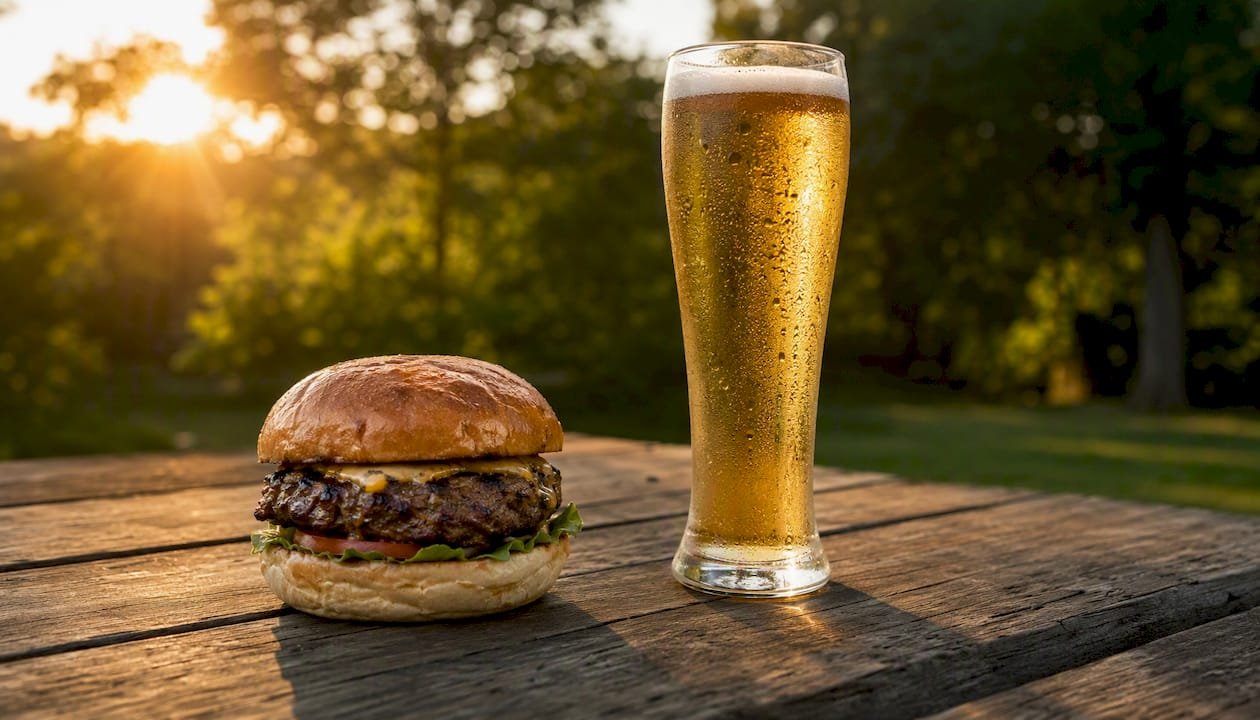
Intensity: medium. Mechanism: cut/complement.
2. Cheeseburger
Cheese changes everything. Melted cheddar or American-style cheese adds salt, fat, and a creamy texture that a plain lager can struggle to handle. An amber ale or a malty pale ale brings enough body to complement the dairy fat while its moderate bitterness keeps the palate from going heavy. The Gentleman’s Journal specifically flags malt-forward styles for beef and cheese combinations.
Intensity: medium-bold. Mechanism: complement.
3. Bacon and BBQ burger
Smoke, sweetness, and salt are the three pillars here. A smoked porter mirrors the smokiness directly (complement), while its roasted malt body handles the fat from the bacon. Brown ale is a softer option that picks up the caramel notes in BBQ sauce without overwhelming. Avoid very hoppy beers: the bitterness clashes with sweet BBQ glaze and turns metallic. UK craft beer guidance consistently points malty and darker beers at BBQ beef.
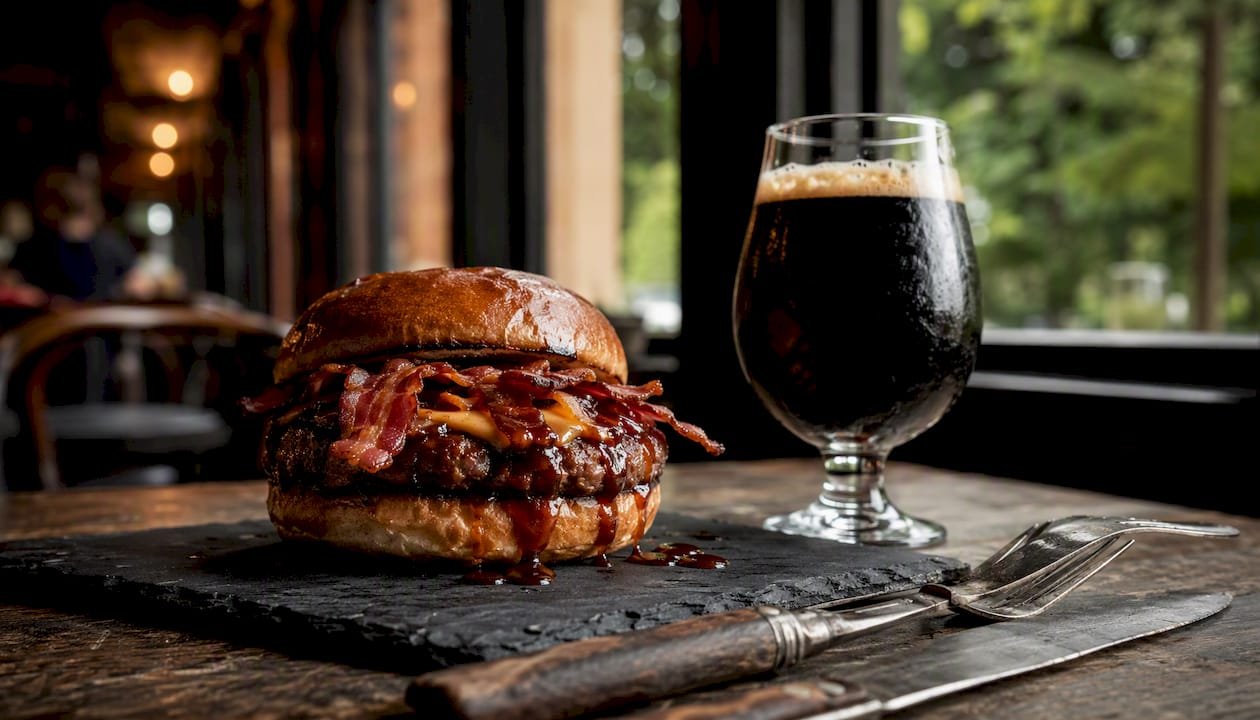
Intensity: bold. Mechanism: complement.
4. Lamb burger
Lamb is earthy, fatty, and carries a distinctive gamey note that lighter beers cannot anchor. A session IPA or a well-hopped pale ale provides enough bitterness to contrast the fat and cut through the earthiness. If the lamb is spiced with cumin or harissa, a saison with its peppery, fruity esters is an excellent match. The Gentleman’s Journal recommends hoppy styles for lamb specifically because the bitterness lifts rather than fights the meat’s character.
Intensity: medium-bold. Mechanism: contrast/cut.
5. Fried chicken burger
The coating is the pairing challenge: crispy, oily, often seasoned with salt and sometimes spice. A Hefeweizen or a crisp pilsner cuts the oil cleanly and the carbonation scrubs the coating off the palate. The banana and clove esters in a Hefeweizen also complement any mild spice in the seasoning. For a spicier Nashville-style chicken burger, a lower-ABV pilsner or a slightly sweet wheat beer keeps the heat manageable. For more on handling heat with beer, the beer with spicy food guide covers this in detail.
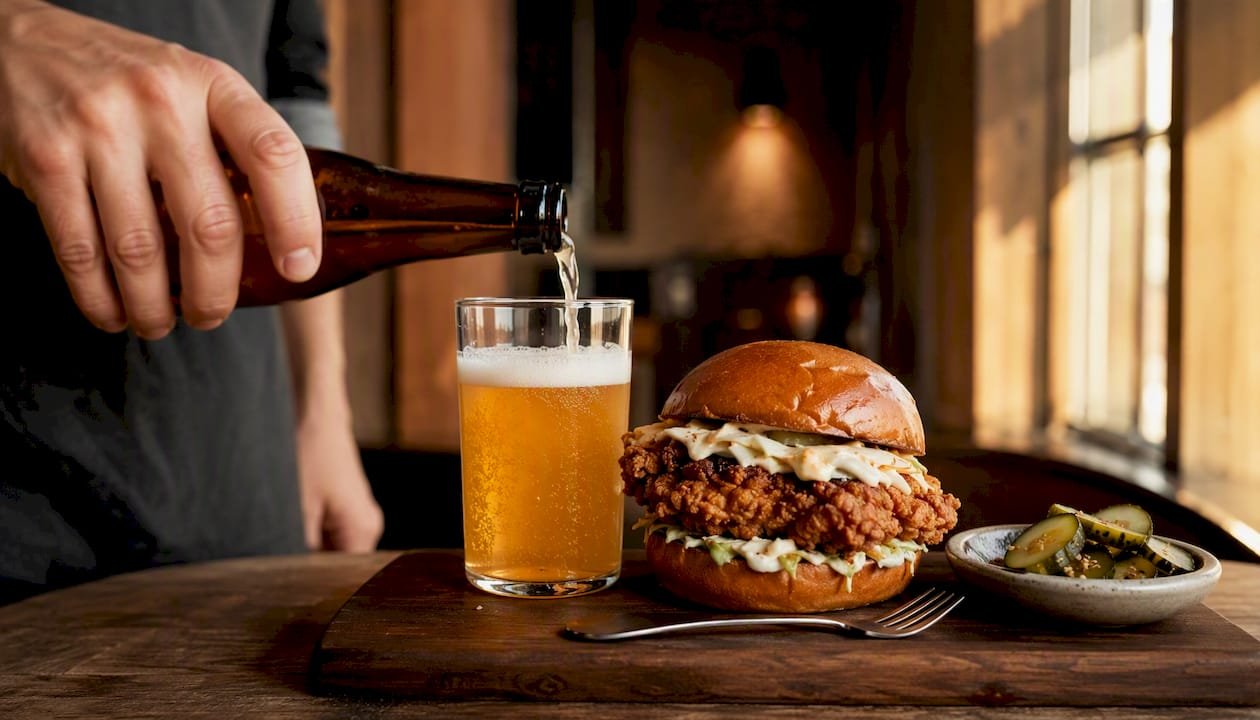
Intensity: light-medium. Mechanism: cut.
6. Turkey burger
Turkey is lean and mild, which means the beer must not overpower it. A golden ale or a saison brings enough flavour interest to make the pairing worthwhile without burying the meat. Saison’s carbonation also handles the slight dryness of turkey well. Avoid stouts or strong IPAs here; they simply erase the burger.
Intensity: light. Mechanism: complement.
7. Venison or game burger
Game meat is rich, iron-forward, and deeply savoury. It needs a beer with real body and complementary roasted or dark-fruit notes. A robust porter or a red ale works well: the porter’s roasted malt echoes the meat’s depth, while a red ale’s caramel malt softens the iron note. Carbonation still matters for cutting the fat, so avoid nitrogen-poured stouts here unless the burger is very lean.
Intensity: bold. Mechanism: complement.
8. Veggie and vegan burger
The pairing logic shifts with plant-based patties because the dominant flavours come from seasoning, texture, and any cheese or sauce rather than meat fat. A fruity pale ale or a sour beer provides contrast that lifts the vegetables and spices. Craftbeer maps fruity and sour styles to vegetable-forward dishes. If the veggie burger is heavily spiced (think black bean and chipotle), a saison or a session IPA handles both the spice and the earthiness.
Intensity: light-medium. Mechanism: contrast.
How toppings and sauces change which beer you should choose
Toppings often matter more than the patty itself. A plain beef burger with blue cheese is a fundamentally different pairing challenge from the same patty with pickles and mustard.
The Cicerone® pairing framework teaches candidates to treat each flavour element separately and then find the beer that handles the dominant one. When two elements pull in opposite directions, prioritise the stronger flavour and use carbonation or serving temperature to manage the secondary one.
Quick rules by sauce and topping type:
- BBQ sauce (sweet/smoky): lean into complement; choose a brown ale, smoked porter, or amber. Avoid very bitter beers.
- Mustard (sharp/acidic): high carbonation cuts through; a crisp pilsner or a dry saison works well.
- Aioli (rich/fatty): carbonation is your friend; a highly carbonated pale ale or lager scrubs the fat cleanly.
- Blue cheese (salty/pungent): residual sweetness in a milk stout or a Belgian dubbel complements and softens the sharpness.
- Pickles (acidic/briny): a tart gose or a highly carbonated pilsner mirrors the acidity and refreshes the palate.
- Jalapeños (spicy/vegetal): lower ABV and residual sweetness reduce heat amplification; a wheat beer or a mango-forward pale ale works.
| Topping type | Recommended beer style | Mechanism |
|---|---|---|
| Sweet (BBQ sauce, caramelised onions) | Brown ale, amber ale | Complement |
| Acidic (pickles, mustard) | Pilsner, gose, dry saison | Cut/contrast |
| Fatty (aioli, extra cheese) | Highly carbonated pale ale, lager | Cut |
| Spicy (jalapeños, hot sauce) | Wheat beer, low-ABV pale ale | Contrast |
| Salty/pungent (blue cheese, anchovies) | Milk stout, Belgian dubbel | Complement |
Does serving temperature really change the pairing?
Yes, and more than most people expect. The Institute of Hospitality is direct on this: serving beer too cold hides aroma and flavour. When the attributes that make a pairing work, hop aroma, malt sweetness, ester character, are suppressed by over-chilling, the beer tastes flat against the food and the pairing fails before it starts.
Carbonation also functions as texture. High CO2 pours provide palate scrubbing; nitrogen or low-CO2 pours reduce the cut effect and favour creamy, complementary matches. A nitro stout poured alongside a soft cheese topping works beautifully precisely because it is not scrubbing the palate clean. For a fatty beef burger, you want CO2 carbonation doing the work. The Cicerone® curriculum treats carbonation as a textural ingredient rather than just a delivery mechanism.
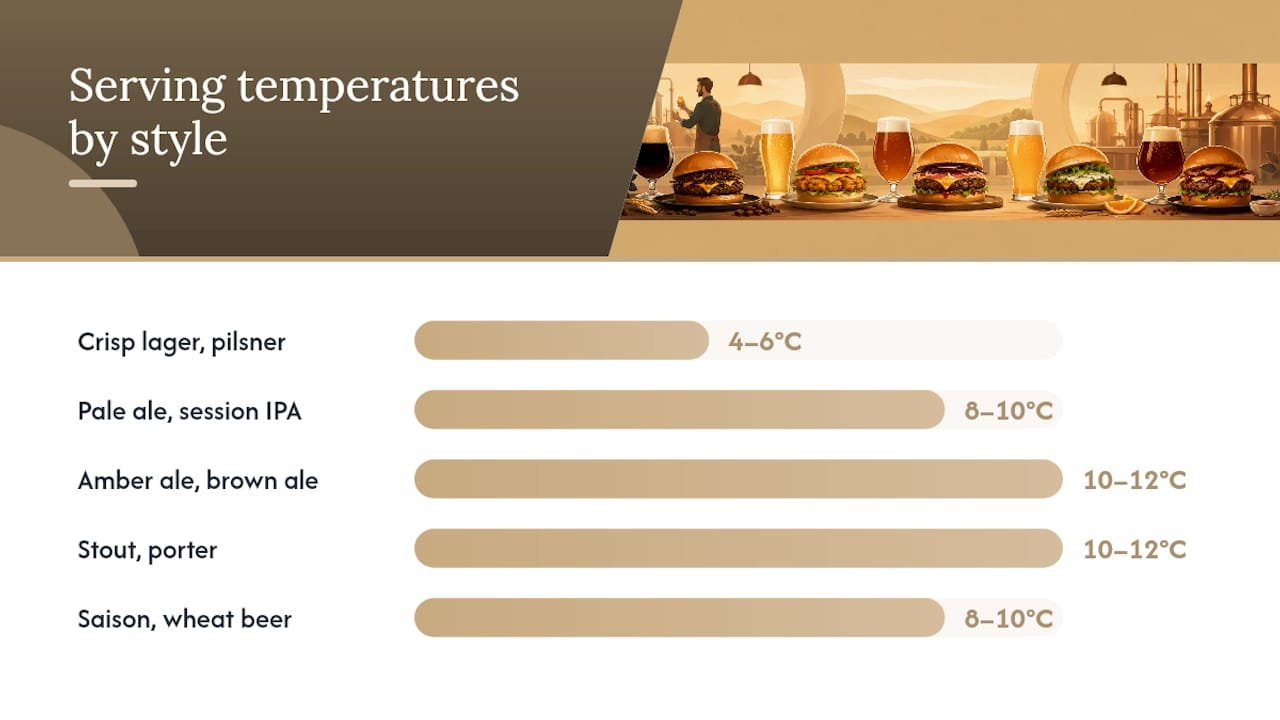
| Beer style | Serve temperature | Why it matters for pairing |
|---|---|---|
| Crisp lager, pilsner | 4–6°C | Keeps cut function sharp; preserves clean bitterness |
| Pale ale, session IPA | 8–10°C | Allows hop aroma to open; bitterness stays balanced |
| Amber ale, brown ale | 10–12°C | Malt sweetness and caramel notes become more expressive |
| Stout, porter | 10–12°C | Roasted character and body come forward; aroma fully opens |
| Saison, wheat beer | 8–10°C | Ester and spice notes (banana, clove, pepper) emerge properly |
Glassware matters for the same reason. A tulip glass concentrates aroma at the rim, which is why a saison or a fruity pale ale paired with a veggie burger benefits from one. A straight pint glass is fine for a lager with a beef burger, where you want carbonation over aroma. For a full breakdown, the beer glassware guide covers every style.
Pro Tip: Pull your craft ales and IPAs from the fridge 10 minutes before serving. That small window is enough to let the aroma open without the beer going warm.
For a full style-by-style temperature reference, the beer serving temperature guide is worth bookmarking.
How to taste and test pairings properly
The academic research on expert pairing shows that specialists use a structured sensory process rather than instinct. You can replicate that at home or in a taproom with a simple method.
- Start with a neutral palate. Drink water and avoid strong flavours (coffee, mints) for 20 minutes before tasting.
- Taste the beer alone. Note the dominant flavours: bitter, malty, fruity, roasty, sour. Identify the intensity (light/medium/bold).
- Taste the burger alone. Note fat level, dominant seasoning, char, sweetness from any glaze or sauce.
- Taste them together. Pay attention to what happens: does the beer cut through the fat cleanly? Do any flavours amplify each other? Does the burger taste better, worse, or just different?
- Record three cues: palate cleanness after the sip (1–5), flavour harmony (do they belong together?), and any lingering aftertaste (pleasant or not).
- Try a second beer style with the same burger and compare directly.
Pro Tip: In a taproom, ask for a third-pint pour rather than a full pint when testing multiple beers. You get the full flavour without the volume, and you can compare three styles side by side without losing your palate. Always drink water between samples and eat plain bread to reset.
Lost And Found Taproom is a good place to run this experiment. The rotating beer list means you will rarely find the same lineup twice, and the street-food collaborations, including the Boxx BBQ partnership, give you real burgers to work with. Staff are happy to suggest pairings from whatever is on tap that day. For guided tasting options in Brighton, the beer tasting Brighton guide lists local providers.
Drink responsibly: when tasting multiple beers, keep pours small, eat food throughout, and pace yourself.
Your quick cheat sheet for BBQs and pub visits
When you are standing at the grill or scanning a pub menu, you need the answer in five seconds. The table below gives you the fastest possible lookup. The general rule on mechanism: choose a cleansing beer (high carbonation, bitter) when the burger is fatty, saucy, or rich; choose a complementary beer (malty, roasty, fruity) when the burger has strong flavour notes you want to echo.
| Burger type | Beer style | Mechanism |
|---|---|---|
| Classic beef | Crisp lager / Czech pilsner | Cut |
| Cheeseburger | Amber ale / malty pale ale | Complement |
| Bacon and BBQ | Smoked porter / brown ale | Complement |
| Lamb | Session IPA / pale ale | Contrast/cut |
| Fried chicken | Hefeweizen / pilsner | Cut |
| Spicy chicken | Wheat beer / low-ABV pale ale | Contrast |
| Turkey | Golden ale / saison | Complement |
| Venison or game | Robust porter / red ale | Complement |
| Veggie or vegan | Fruity pale ale / gose | Contrast |
| Blue cheese topping | Milk stout / Belgian dubbel | Complement |
| Pickles or mustard | Pilsner / dry saison | Cut |
CraftBeer.com’s beer and food chart organises these flavour families further if you want to explore beyond the list. Pub operators who pair by style rather than brand, as Morning Advertiser’s Pub Love feature documents, find that customers try more variety and enjoy the experience more.
Why pairing is worth the effort
Most people pick a beer and a burger separately and eat them in parallel. That is fine. But a considered pairing does something different: it creates a third experience that neither the beer nor the burger produces alone. A smoked porter alongside a bacon cheeseburger does not just taste like porter and burger; the smoke in the beer amplifies the char on the patty, the malt softens the salt, and the carbonation keeps the whole thing from feeling heavy.
Beer & Brewer notes that beer spans a wider range of flavour families than wine, from sweet and roasty to sour and juicy, which means the same burger can work with multiple styles depending on what you want to highlight. That is not a complication; it is an invitation. There is no single correct answer, and the most interesting pairings often come from local beers you have never tried before. Local culinary identity shapes pairing choices in ways that a generic style guide cannot fully capture, which is why exploring local food and drink scenes tends to produce the most memorable combinations.
My honest advice: start with the cheat sheet, then break it deliberately. Try a sour with a beef burger and see what happens. The rules exist to give you a starting point, not a ceiling.
Try these pairings at Lost And Found Taproom
Lost And Found Taproom in Brighton’s Fiveways neighbourhood rotates its beer list constantly, which makes it an ideal place to test these combinations without committing to a full pint of something that might not work. The tap list spans crisp lagers, hoppy pale ales, malty ambers, and darker styles from independent UK breweries, so most of the pairings in this guide are available on any given visit.
The taproom’s street-food collaborations bring real burgers into the mix. Check the beer menu online before you visit to see what is currently pouring, and ask the staff which styles they would pair with whatever food is on that day. They know the beers well and enjoy the conversation. If you want a starting point for the visit, the summer beer guide highlights five Brighton craft beers worth trying, several of which sit squarely in the amber and pale ale territory that works best with burgers.
Sources
- Craftbeer
- How to create the best beer and food pairings | Wine & Spirit Education Trust
- Small but perfectly foamed – Institute of Hospitality
- GAME. SET. MATCH. – Beer & Brewer
- Beer and Food Pairing Principles for Cicerone® Candidates | National Beer Authority
- Match beer to burger – The Gentleman’s Journal
- Burger and beer pairings Pub Love
- From beverage to companion food: Experts’ principles for pairing wines and beers with food
Recommended
- Beer with spicy food: what to drink with curry and wings
- Why @boxxbbq is the Perfect Match for Craft Beer at Lost and Found Taproom – Lost And Found Craft Beer Taproom Brighton
- Why @boxxbbq is the Perfect Match for Craft Beer at Lost and Found Taproom – Lost And Found Craft Beer Taproom Brighton
- Top 5 Craft Beer Providers for Stout vs Porter 2026