


IPA styles explained: your complete guide to every type
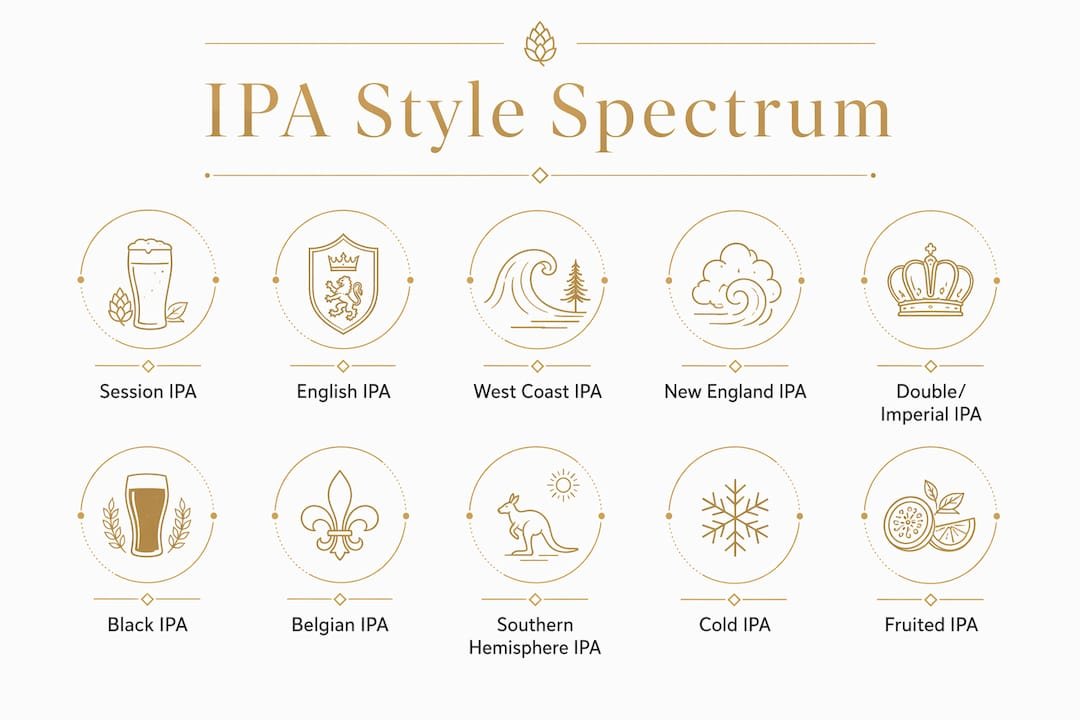
An IPA is a hop-forward pale ale defined by its emphasis on hop aroma and flavour above all else. The term covers a wide family of sub-styles, each expressing hops and balance differently. Here are the main ones you will encounter:
- English IPA — floral, earthy, malty backbone; moderate bitterness
- West Coast IPA — clear, dry, piney and resinous with firm bitterness
- New England / Hazy IPA (NEIPA) — opaque, soft, juicy tropical fruit, low perceived bitterness
- Session IPA — lower ABV, hop-forward, very drinkable
- Double / Imperial IPA — high ABV, intense hopping, residual sweetness
- Black IPA / Cascadian Dark Ale — roasted malt meets hop bitterness
- Belgian IPA — yeast-driven esters and phenols with strong hop aroma
- New Zealand / Southern-hemisphere IPA — distinctive passionfruit, gooseberry and lime character
- Fruited IPA — real fruit or lactose additions layered over hop character
- Cold IPA — dry, crisp, lager-like texture with intense hop aroma
New to IPAs? Start with a Session IPA or a classic West Coast. They are the clearest expression of what the style is about without overwhelming your palate.
Table of Contents
- What exactly is an IPA, and where did it come from?
- English IPA: the original, and still worth knowing
- West Coast IPA: crisp, piney and unapologetically bitter
- New England IPA: hazy, juicy and softer than it looks
- Session IPA: the best place to start
- Double and Imperial IPA: when more is the point
- Black IPA: roasted malt meets hop bitterness
- Belgian IPA: yeast character changes everything
- New Zealand and southern-hemisphere IPAs: a different hop language
- Cold IPA and other modern technique-driven variants
- Fruited IPAs: what “fruited” actually means
- How to taste and assess an IPA properly
- Which IPA should a beginner try first?
- How to explore IPA styles across the UK
- Key takeaways
- Why rotating IPAs is the only honest way to run a tap list
- Taste every IPA style at Lost And Found Taproom, Brighton
- Useful sources and further reading
What exactly is an IPA, and where did it come from?
IPA stands for India Pale Ale. The popular story links it to 19th-century British brewers shipping heavily hopped pale ales to India, where extra hops supposedly acted as a preservative. That origin story is largely legend, though the British brewing heritage is real enough. What matters today is that modern brewers use the IPA label primarily to signal a hop-forward balance rather than any strict historical recipe.
The technical markers are consistent across styles: prominent hop aroma and flavour delivered through late kettle additions and dry hopping, a pale malt base that supports rather than dominates, and bitterness measured in IBUs (International Bitterness Units). IBUs are a chemical measure of iso-alpha acids, but they do not tell the whole story. Late hopping and dry hopping can pile on intense hop aroma without raising perceived bitterness, which is why a 70 IBU NEIPA can taste softer than a 45 IBU West Coast. ABV typically runs from low levels in Session IPAs to high in Triple IPAs, with most standard IPAs sitting in a moderate to moderately high range.
The BJCP style guidelines treat IPA as a balance-and-hop category rather than a colour or strength category, which is why the family now includes black, white, Belgian and hazy variants. Ignore the words “India” and “Pale” entirely. Focus instead on the hop profile and how bitterness, aroma and malt interact.
Pro Tip: When reading a tap list, look at the listed hop varieties rather than the style name. The hops tell you more about what the beer will taste like than any sub-style label.
English IPA: the original, and still worth knowing
The English IPA is where the modern family began. It is noticeably different from its American descendants — softer, more balanced, and with a malt presence that actually wants to be noticed.
| Feature | English IPA |
|---|---|
| Appearance | Golden to light amber; clear; off-white head |
| Aroma & flavour | Floral, earthy, herbal hops; biscuit and toast malt; light fruitiness |
| Bitterness (IBU) | Moderate to moderately high IBUs |
| Typical ABV | moderate to moderately high ABV |
| Hop varieties | Fuggles, East Kent Goldings, Challenger |
| Mouthfeel | Medium body; moderate carbonation; not dry |
The malt backbone is the key distinction. English IPAs carry a biscuity, bread-like quality from pale malt and sometimes a touch of crystal malt, and the yeast contributes light stone-fruit esters that American styles deliberately suppress. Fuggles and East Kent Goldings deliver earthy, floral and slightly spicy notes rather than the citrus punch of American hops.
Compared to a West Coast IPA, the English version feels rounder and less aggressive. Bitterness is present but not the dominant impression. If you find modern American IPAs too sharp or one-dimensional, an English IPA is worth revisiting.
West Coast IPA: crisp, piney and unapologetically bitter
West Coast IPA is the style most people picture when they hear “IPA.” It is clear, dry, and built around assertive bitterness with resinous pine and citrus on top.
| Feature | West Coast IPA |
|---|---|
| Appearance | Clear gold to light amber; white head |
| Aroma & flavour | Pine, resin, grapefruit, citrus peel, tropical hints |
| Bitterness (IBU) | high perceived bitterness (around 70 IBU) |
| Typical ABV | moderate to moderately high ABV |
| Hop varieties | Cascade, Chinook, Centennial, Citra, Simcoe |
| Mouthfeel | Dry, crisp, medium-light body |
The BJCP’s American IPA definition describes it as “decidedly hoppy and bitter” with a “dryish finish” and a clean malt base that steps back to let the hops lead. That dryness is not accidental. Brewers use sulphate-heavy water chemistry to accentuate bitterness and achieve a clean, snappy finish. Late kettle hopping adds aroma without softening the body.
- Cascade hops brought grapefruit and floral notes to the style from the 1970s onwards
- Chinook and Simcoe add the resinous pine character that defines the West Coast signature
- Citra and Mosaic push tropical fruit notes while keeping the dry finish intact
Pro Tip: Sulphate levels in the brewing water directly sharpen perceived bitterness. A West Coast IPA brewed with high-sulphate water will taste drier and crisper than the IBU number alone suggests.
New England IPA: hazy, juicy and softer than it looks
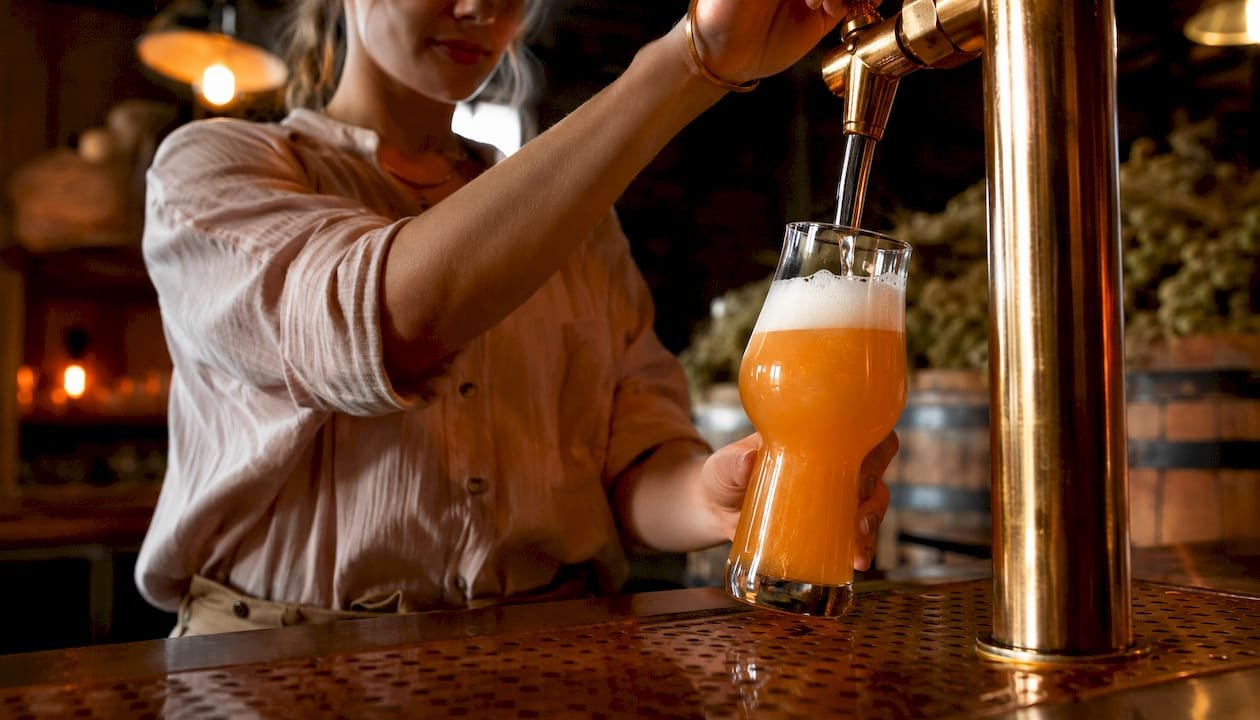
The NEIPA (New England IPA) looks like cloudy orange juice and tastes like a tropical fruit smoothie crossed with a hop bomb. It is the most popular IPA style in UK craft beer right now, and it is genuinely different in technique, not just marketing.
| Feature | NEIPA / Hazy IPA |
|---|---|
| Appearance | Opaque; straw to deep gold; hazy throughout |
| Aroma & flavour | Intense mango, passionfruit, peach, citrus; low bitterness |
| Bitterness (IBU) | Moderate on paper; soft in perception |
| Typical ABV | moderate to moderately high ABV |
| Hop varieties | Citra, Mosaic, Galaxy, Sabro, El Dorado |
| Mouthfeel | Soft, creamy, medium-full body |
The haze comes from protein-polyphenol haze compounds, not from poor brewing. Brewers add flaked oats and wheat to the grist, which contributes to the soft, pillowy mouthfeel and the permanent haze. Heavy dry hopping during active fermentation — a process called biotransformation — converts hop compounds into new aromatic molecules that emphasise tropical fruit over bitterness.
A genuine NEIPA should have intense fruit aroma, a creamy body and no harsh astringency. The BJCP’s hazy IPA entry flags what to watch for as faults: a buttery or diacetyl aroma, raw starchy texture, or excessive particulate matter that makes the beer look muddy rather than hazy. If it smells grassy or tastes thin and watery, it is not a well-made NEIPA regardless of the label.
Curious whether hazy IPAs are still as popular as they were at their peak? The short answer is that they remain dominant, but drinkers are increasingly discerning about quality.
Session IPA: the best place to start
Session IPA keeps the hop character of a full-strength IPA but drops the ABV to a level where you can have two or three without losing the evening.
| Feature | Session IPA |
|---|---|
| Appearance | Pale gold to gold; clear to lightly hazy |
| Aroma & flavour | Citrus, tropical, floral; clean and refreshing |
| Bitterness (IBU) | moderate bitterness (around 45 IBU) |
| Typical ABV | low ABV |
| Hop varieties | Citra, Mosaic, Amarillo, Simcoe |
| Mouthfeel | Light to medium-light; crisp finish |
Keeping hop aroma high at low ABV is harder than it sounds. Less alcohol means less body, which can make bitterness feel harsh and hop aroma thin. Brewers compensate with later and heavier hopping schedules, lighter crystal malt to avoid sweetness, and sometimes a small addition of wheat for body without weight.
Session IPAs are widely recommended for beginners precisely because they deliver the hop experience without the alcohol intensity. If you have been curious about IPAs but found them too strong or too bitter, a well-made Session IPA is the honest answer.
Double and Imperial IPA: when more is the point
Double IPA (DIPA) and Imperial IPA are the same thing under different names. Both signal a beer that has been scaled up in every direction: more hops, more malt, more alcohol, and a richer, fuller mouthfeel.
| Feature | Double / Imperial IPA |
|---|---|
| Appearance | Gold to light amber; clear to slightly hazy |
| Aroma & flavour | Intense citrus, tropical, resin; residual sweetness |
| Bitterness (IBU) | Very high (60–100+ IBU) but balanced by malt |
| Typical ABV | high ABV |
| Hop varieties | Citra, Simcoe, Mosaic, Chinook, Columbus |
| Mouthfeel | Medium-full to full; warming alcohol |
The extra malt is not there for flavour so much as structure. Without it, the extreme hopping would produce a harsh, unbalanced beer. The residual sweetness cushions the bitterness and gives the beer enough body to carry the alcohol. Triple IPAs push ABV above 10% and are genuinely sipping beers rather than session drinks.
One thing worth knowing: hop aroma fades faster in high-ABV IPAs than in session-strength ones. A DIPA that has been sitting on a shelf for three months will taste malty and boozy with little of the tropical or citrus character it had fresh. Buy them fresh, drink them soon.
Black IPA: roasted malt meets hop bitterness
Black IPA sits at an odd crossroads. It looks like a stout, smells like an IPA, and tastes like neither quite fully. That tension is exactly what makes it interesting.
| Feature | Black IPA / Cascadian Dark Ale |
|---|---|
| Appearance | Dark brown to black; tan to off-white head |
| Aroma & flavour | Pine, citrus, resin hops over roast, coffee, dark chocolate |
| Bitterness (IBU) | firm bitterness |
| Typical ABV | moderate to high ABV |
| Hop varieties | Chinook, Cascade, Columbus, Centennial |
| Mouthfeel | Medium to medium-full; dry finish |
The roast character comes from dehusked dark malts, which give colour and coffee notes without the heavy astringency of a stout. The hop bill is typically West Coast in character: pine, resin and citrus. The result is a beer where bitterness comes from two directions at once, which can be either thrilling or exhausting depending on your palate.
The naming debate is real. Pacific Northwest brewers prefer “Cascadian Dark Ale” to honour the regional origin and avoid the apparent contradiction of a “black pale ale.” The BJCP uses “Black IPA” for competition purposes. Both terms refer to the same style.
Belgian IPA: yeast character changes everything
Belgian IPA takes the hop-forward intensity of an American IPA and runs it through a Belgian yeast strain. The result is genuinely different from anything else in the IPA family.
| Feature | Belgian IPA |
|---|---|
| Appearance | Gold to light amber; clear to slightly hazy |
| Aroma & flavour | Banana, pear, clove, peppery phenols plus citrus/tropical hops |
| Bitterness (IBU) | high perceived bitterness |
| Typical ABV | moderate to high ABV |
| Hop varieties | Saaz, Styrian Goldings, or American varieties |
| Mouthfeel | Medium body; higher carbonation; dry finish |
Belgian yeast strains produce esters (banana, pear, stone fruit) and phenols (clove, pepper, spice) during fermentation. In a Belgian IPA, those yeast-derived flavours compete and collaborate with the hop character rather than staying out of the way. The balance is delicate. Too much yeast character and the hops get lost; too little and you wonder why you bothered with Belgian yeast at all.
On a taproom list, Belgian IPAs often sit between the standard IPAs and the Belgian ales. They suit drinkers who enjoy both categories but want something that does not fit neatly into either.
New Zealand and southern-hemisphere IPAs: a different hop language
New Zealand and Australian hop varieties produce flavour compounds that simply do not exist in European or American hops. The result is a recognisably IPA-shaped beer that tastes like nothing else.
| Feature | NZ / Southern-hemisphere IPA |
|---|---|
| Appearance | Gold to light amber; clear to lightly hazy |
| Aroma & flavour | Passionfruit, gooseberry, lime, white grape, fresh herbs |
| Bitterness (IBU) | moderate to moderately high bitterness |
| Typical ABV | moderate to moderately high ABV |
| Hop varieties | Nelson Sauvin, Motueka, Galaxy, Riwaka |
| Mouthfeel | Medium body; clean, dry finish |
Nelson Sauvin is the most distinctive: it carries a white wine and gooseberry character derived from thiol compounds that overlap with Sauvignon Blanc. Galaxy, grown in Australia, delivers intense passionfruit and citrus. Motueka brings lime and tropical notes with a slightly herbal edge. These flavours come from the specific growing conditions of the southern hemisphere, where different soils, UV levels and climate produce different essential oil profiles in the hop cone.
A beer brewed with Nelson Sauvin is immediately identifiable even to someone who has never heard of the variety. That distinctiveness is the point.
Cold IPA and other modern technique-driven variants
Cold IPA is the newest style to gain genuine traction. It was developed in the United States around 2021 and has since appeared on UK tap lists with increasing frequency.
The defining technique is fermentation at lager-like temperatures using a clean ale or lager yeast, combined with adjuncts such as rice or corn to thin the body and dry out the finish. The result is an IPA that has the hop intensity of a West Coast but the crisp, clean texture of a cold-filtered lager. Perceived bitterness is high, but the finish is exceptionally dry and refreshing.
Other modern variants worth knowing:
- Brut IPA — uses amyloglucosidase enzyme to convert all residual sugars, producing a bone-dry, champagne-like finish with very low sweetness
- White IPA — brewed with wheat and coriander in the witbier tradition, producing a hazy, spiced, lighter-bodied IPA
- Rye IPA — rye malt adds a spicy, earthy backbone and a slightly slick mouthfeel
Pro Tip: Cold IPAs are best served at the lower end of the IPA temperature range (around 6–8°C). The cold temperature amplifies the crisp, clean texture that defines the style.
These technique-led styles reflect what the IPA category has always been: a canvas for experimentation rather than a fixed recipe.
Fruited IPAs: what “fruited” actually means
There is an important distinction between an IPA that tastes fruity and an IPA that has had fruit added to it. Both exist, and they are not the same thing.
Hop-derived fruitiness comes from compounds in the hop oil itself. Citra hops genuinely smell of lime and passionfruit without a single piece of fruit going near the kettle. That is natural hop character, and it is what most IPAs labelled “tropical” or “citrus-forward” are delivering.
A fruited IPA, by contrast, has real fruit (or fruit purée, juice, or extract) added during or after fermentation. Common additions include:
- Grapefruit — often added as zest or juice to amplify the citrus already present in the hops
- Mango and passionfruit — popular in NEIPAs, where they reinforce the tropical hop character
- Raspberry and blueberry — less common, used in more experimental releases
Milkshake IPAs take this further by adding lactose (milk sugar), which is unfermentable and stays in the beer as sweetness and body. The result is a thick, dessert-like IPA that sits at the outer edge of the style. Whether it counts as a “real” IPA is a debate that has been running since the style emerged, but it is worth knowing what you are ordering.
The key question to ask: is the fruit character coming from the hops, or has something been added? The answer changes the balance, the mouthfeel, and how the beer ages.
How to taste and assess an IPA properly
Getting the most from an IPA is partly about the beer and partly about how you approach it. A few simple habits make a real difference.
Glassware matters more than most people think. A tulip glass or a shaker pint both work, but a tulip concentrates aroma at the rim and lets you nose the beer properly before you taste it. For a detailed breakdown of which glass suits which style, the beer glassware guide is worth a look.
Serving temperature varies by style:
- Session and West Coast IPAs: 7–10°C (cold enough to be refreshing, warm enough to show hop aroma)
- NEIPA and fruited IPAs: 8–11°C (slightly warmer to open up the tropical aromas)
- Double IPA and English IPA: 10–13°C (warmer temperatures reveal complexity and malt character)
Tasting checklist:
- Appearance — colour, clarity, head retention. Is it hazy or clear? Deep gold or amber?
- Aroma — nose the glass before you sip. Citrus? Pine? Tropical fruit? Earthy? Floral?
- First sip — what hits first? Bitterness, sweetness, or fruit?
- Mid-palate — does the malt show up? Is the body light, medium or full?
- Finish — dry or sweet? Does bitterness linger or fade quickly?
- Balance — do the hops, malt and bitterness work together, or does one dominate uncomfortably?
For a more structured approach to tasting at home, working through a flight of two or three styles side by side is the fastest way to train your palate.
Pro Tip: Pour the beer gently down the side of the glass to preserve carbonation, then give it thirty seconds before nosing. Carbonation can mask aroma when the beer is freshly poured.
Which IPA should a beginner try first?
The honest answer is: start with a Session IPA or a straightforward West Coast, and work outward from there. Here is a simple progression that makes sense for most palates:
- Session IPA — low ABV, approachable bitterness, clear hop character without intensity
- West Coast IPA — the classic expression; dry, bitter, piney. This is the benchmark
- NEIPA — once you know what a West Coast tastes like, the contrast with a hazy is striking
- English IPA — go back to the origin; the malt and yeast character will make more sense now
- Double IPA — when you are ready for more of everything
- Belgian IPA, Black IPA, NZ IPA — once you have the core styles, these hybrids make sense
At a taproom, order a flight. Most good taprooms will let you try four or five small pours, which is the fastest way to understand how styles differ. Ask the staff which IPAs are freshest — hop aroma degrades over time, and a three-week-old NEIPA will taste noticeably flatter than one poured from a fresh keg.
Pro Tip: When reading a tap list, check the ABV and the listed hop varieties before the style name. A 4.2% beer with Citra and Mosaic is almost certainly a Session IPA regardless of what it is called. A 7.8% beer with Nelson Sauvin is going to taste of white wine and passionfruit whether the menu says “NZ IPA” or not.
How to explore IPA styles across the UK
The UK has never had a better range of IPAs on tap, in cans, and in bottle shops. The challenge is not finding them — it is knowing how to navigate the choice.
Where to try multiple styles:
- Independent taprooms with rotating lines are the most efficient way to taste broadly. A good taproom will have four to eight IPAs on at any one time, spanning styles and breweries
- CAMRA beer festivals run throughout the year and often dedicate sections to IPA styles, with knowledgeable volunteers who can guide you
- Specialist bottle shops let you take a selection home and taste at your own pace
Sampler strategies:
- Always ask for a flight rather than committing to a full pint of something unfamiliar
- Ask staff for the freshest IPA on the list, not necessarily the most interesting-sounding one
- Note the brewery and the hop varieties when you find something you like — that is more useful than remembering the style name
Lost And Found Taproom in Brighton’s Fiveways neighbourhood rotates its IPA selection regularly, pulling from independent UK breweries and occasionally from further afield. The rotating beer menu is available online, so you can check what is currently pouring before you visit. The taproom also runs tasting events that pair styles with street food, which is one of the more enjoyable ways to work through several IPAs in a single evening.
Pro Tip: Pair a West Coast IPA with something salty or fatty — crisps, charcuterie, fried food. The bitterness cuts through fat in the same way a dry white wine does. A NEIPA works better with spiced or fruity dishes where the tropical hop character can echo the food.
Key takeaways
IPA styles differ most meaningfully in three dimensions: hop technique (late hopping versus dry hopping versus biotransformation), malt and grist choices (pale and dry versus oat-heavy and soft), and yeast character (clean versus ester-driven).
| Point | Details |
|---|---|
| Start with Session or West Coast | Both styles give a clear, honest expression of hop character without extreme ABV or bitterness. |
| IBUs don’t predict bitterness | Dry hopping and biotransformation boost aroma without raising perceived bitterness, so a 70 IBU NEIPA often tastes softer than a 45 IBU West Coast. |
| Freshness is the biggest quality variable | Hop aroma degrades quickly; always ask for the freshest IPA on the list, especially for NEIPAs and DIPAs. |
| Haze is a technique, not a fault | NEIPA haze comes from oats, wheat and dry-hop timing — a genuine style choice, not a sign of poor brewing. |
| Lost And Found Taproom | Rotates local and UK IPAs across styles; check the current menu online or visit for a guided flight in Brighton. |
Why rotating IPAs is the only honest way to run a tap list
There is a version of the IPA conversation that treats the style as settled — West Coast is the classic, NEIPA is the trend, everything else is a footnote. That framing misses the point entirely.
The IPA category is genuinely alive in a way that most beer styles are not. New hop varieties from New Zealand, Australia and increasingly the UK itself are producing flavour compounds that did not exist in commercial brewing twenty years ago. Cold IPA arrived as a serious style only recently. Brut IPA came and went and left behind a better understanding of enzyme use. The next thing is probably already fermenting somewhere.
What that means practically is that a tap list frozen in time — the same four IPAs, the same breweries, month after month — is not just boring. It is actively misleading about what the style can do. Rotation is not a marketing gimmick. It is the only way to show the full range of what hop-forward brewing has become.
The other thing worth saying: taproom staff knowledge matters enormously here. A good member of staff who knows which keg went on yesterday and which hop variety is doing something unexpected in the current NEIPA is more useful than any style guide, including this one. Ask questions. The best taproom experiences happen when you treat the bar as a resource rather than a vending machine.
Taste every IPA style at Lost And Found Taproom, Brighton
Lost And Found Taproom in Brighton’s Fiveways is one of the most direct routes to working through the IPA spectrum in a single visit. The tap list rotates continuously across independent UK breweries, which means you are unlikely to find the same line-up twice. West Coast, NEIPA, Session, Black IPA, NZ-hopped — they come and go as breweries release new batches.
The current beer menu is available online, so you can see exactly what is pouring before you make the trip. The taproom regularly hosts tasting events that pair rotating IPAs with street food, giving you a structured way to compare styles without having to navigate a full pint of each. If you are visiting for the first time, ask the bar staff for a flight built around your bitterness tolerance and hop preference. They know the lines, the freshness dates, and which beers are worth trying while they last.
Useful sources and further reading
- BJCP 2021 Style Guidelines — the authoritative reference for ABV ranges, IBU benchmarks and style definitions across every IPA category; essential for understanding how styles are formally distinguished
- BJCP American IPA entry — detailed sensory expectations, ingredient notes and historical context for the West Coast / American IPA style
- BJCP Hazy IPA entry — covers NEIPA technique, mouthfeel expectations and common faults; the most useful single page for understanding what separates a good hazy from a poor one
- Food & Wine IPA guide — accessible primer on IPA vocabulary (IBU, dry hopping, wet hop) and the style’s role in the modern craft movement; good starting point for beginners
- InsideHook comprehensive IPA guide — broad overview of IPA sub-styles including less common variants; useful for building familiarity with the full range before a taproom visit