




Natural wine explained: a beginner’s guide
Natural wine is wine made with minimal human intervention, from organically or biodynamically farmed grapes, fermented with native yeasts, and produced with little or no additives, fining, or filtration. That is the working definition most producers and merchants use, though as you will see, the term has no legal standing in the UK.
Before you read further, here are the five things that typically mark a natural wine:
- Organic or biodynamic farming — no synthetic pesticides or herbicides in the vineyard
- Native (ambient) yeast fermentation — wild yeasts from the grape skins and winery environment, not commercial packets
- No or very low added sulphur (SO2) — some producers add a tiny amount at bottling; others add none at all
- No commercial additives — no added acids, enzymes, artificial colour, or commercial tannins
- Minimal or no fining and filtration — expect haze and sediment; that is normal
One more thing worth knowing upfront: “natural” is not a legally defined term in the UK or EU. There is no official standard a producer must meet to put it on a label, which means variability between bottles is genuinely part of the experience.
Table of Contents
- What does natural wine actually mean in practice?
- What natural wine is not: clearing up the confusion
- How natural wine is made, step by step
- What do natural wines actually taste like?
- Health, sulphites, and hangovers: what the evidence actually says
- What do UK labels actually tell you about natural wine?
- The sceptics’ case: criticisms and controversies
- How to start buying and tasting natural wine in the UK
- Key takeaways
- Why natural wine rewards patience more than it rewards certainty
- Try natural wine with guidance at Lost And Found Taproom
- Useful sources and further reading
What does natural wine actually mean in practice?
The philosophy behind minimal intervention wine is straightforward: let the grape and the place do the talking, and keep the winemaker’s hand as light as possible. In practice, that translates into a set of choices made in both the vineyard and the cellar.
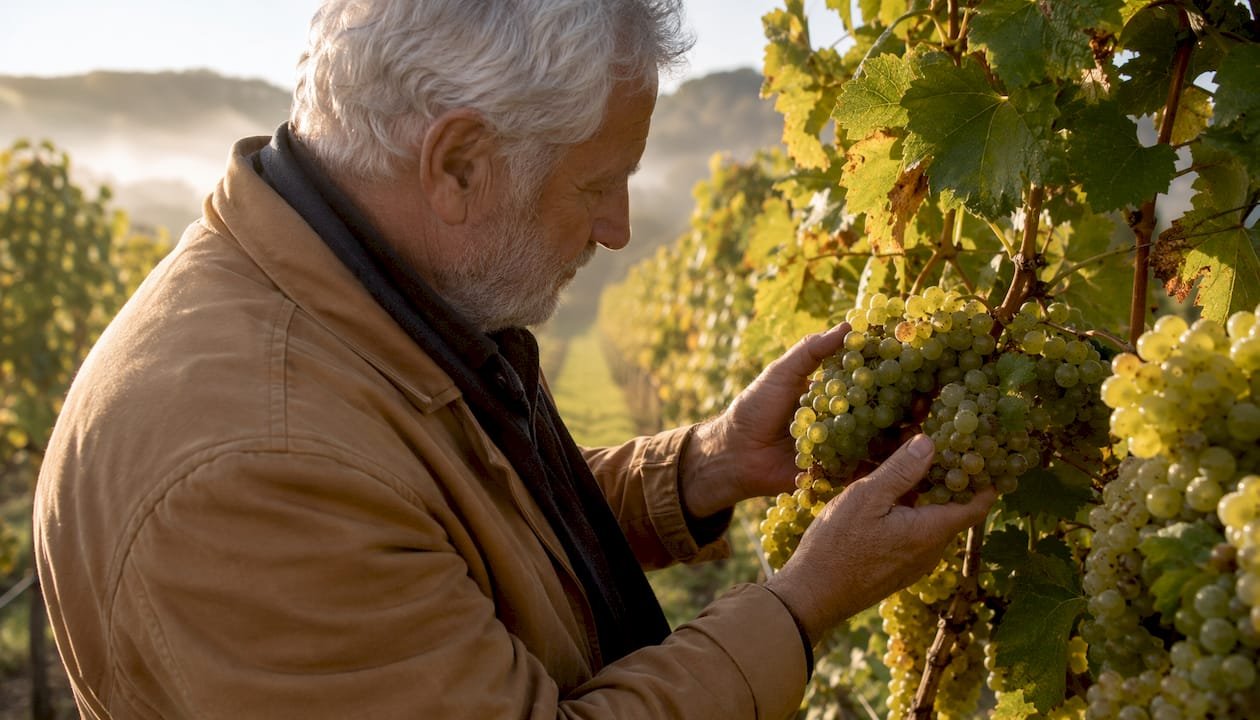
In the vineyard, natural producers work without synthetic chemicals, often following organic or biodynamic principles. Many favour hand-harvesting over machine picking, partly because it allows selective sorting of healthy fruit, and partly because sound grapes are the single most important insurance policy when you plan to use very little sulphur later. Native (ambient) yeasts — the wild populations living on grape skins and in the winery air — drive fermentation rather than commercial yeast strains bred for predictability.
In the cellar, the choices stack up quickly:
- No added commercial yeasts
- No added acids, enzymes, or artificial colour
- No commercial tannins or fining agents (such as egg white, casein, or isinglass)
- Minimal or zero added SO2
- Little or no filtration before bottling
The result is a wine that many producers and experts treat as a spectrum rather than a fixed checklist. You will encounter terms like “low-intervention”, “minimal-sulphur”, and “raw wine” used interchangeably. None of them carry a legal definition; they are shorthand for where a producer sits on that continuum.
A quick glossary for new drinkers:
- Native yeasts — wild microorganisms that occur naturally on grape skins; they create more complex, unpredictable fermentations than commercial strains
- SO2 (sulphur dioxide) — a preservative used to protect wine from oxidation and microbial spoilage; natural producers use far less than conventional ones, or none at all
- Fining — adding a substance (egg white, clay, fish bladder) that binds to particles and drops them out of the wine, leaving it clear
- Filtration — passing wine through a physical filter to remove solids and microbes
- Biodynamic — a farming philosophy that treats the vineyard as a self-sustaining ecosystem, following lunar and cosmic calendars; it goes further than organic certification
Pro Tip: When you are in a wine shop or taproom, the single most useful question you can ask is: “Can you tell me about the cellar practices?” A producer or merchant who can answer that clearly — what yeasts they use, whether they add sulphur, whether the wine is fined — is one worth trusting.
What natural wine is not: clearing up the confusion
The three categories people most often conflate are natural, organic, and biodynamic. They overlap, but they are not the same thing.
- Organic wine carries a certified label (in the UK, look for the Soil Association or EU organic leaf). It means the grapes were farmed without synthetic pesticides, but the winemaker can still use commercial yeasts, fining agents, and a relatively generous SO2 allowance. Organic certification says nothing about cellar practices beyond sulphur limits.
- Biodynamic wine goes further in the vineyard, following the Demeter or Biodyvin certification standards. Again, it does not automatically restrict cellar additives to the degree that natural producers self-impose.
- Natural wine is a philosophy, not a certification. A bottle can be natural without carrying any organic or biodynamic mark, and a certified organic wine can be made with a full toolkit of approved additives.
- Conventional wine sits at the other end. Conventional producers can draw on over 60 approved additives and technical practices that natural producers deliberately avoid.
Two myths worth dispelling directly. First: natural wine does not always mean zero sulphites. Fermentation produces trace SO2 naturally, so even a “no added sulphur” bottle contains some. Second: natural wine does not always taste funky or challenging. Many bottles are clean, fruit-forward, and immediately approachable. The wild, barnyard end of the spectrum is real, but it is not the whole story.
Pro Tip: If you want verifiable accountability rather than a producer’s word, look for certified organic or biodynamic logos on the label, or seek out bottles carrying the French Vin Méthode Nature mark. These are the only claims backed by third-party checks.
How natural wine is made, step by step
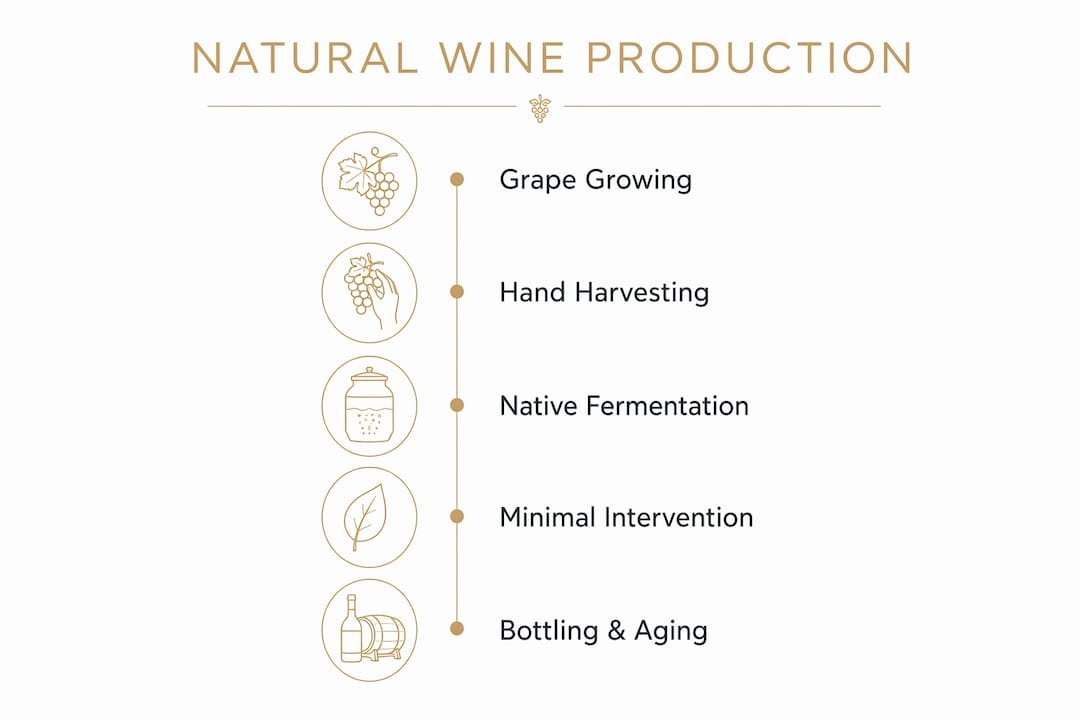
Understanding the production process makes the tasting experience make sense. Here is how a natural wine typically moves from vine to bottle, and where the key decisions happen.
In the vineyard
The foundation is healthy fruit. Natural producers rely on low or zero synthetic inputs, which means the vine must be genuinely robust. Cover crops, compost, and careful canopy management replace herbicides and fungicides. Hand-harvesting allows workers to leave damaged or unripe clusters behind, which matters enormously when you plan to ferment without the safety net of heavy sulphur additions.
In the cellar
- Sorting — grapes are sorted again on arrival, removing anything that could introduce unwanted bacteria
- Crushing or whole-cluster pressing — gentle handling preserves the integrity of the fruit
- Native yeast fermentation — no commercial yeast is added; wild populations begin fermentation spontaneously, often more slowly and unpredictably than commercial strains
- Minimal sulphur management — some producers add a very small amount of SO2 at bottling (often under 50 ppm); others add none at any stage
- No fining or filtration — the wine goes into bottle with its natural solids intact, which is why haze and sediment are common
- Bottling — often done without sterile filtration, which preserves microbial life but also means the wine can continue to evolve (and occasionally referment) in bottle
The movement’s intellectual roots trace back to Jules Chauvet and the Gang of Four in Beaujolais, whose work in the mid-20th century demonstrated that indigenous yeasts and minimal SO2 could produce wines of genuine character and complexity.
The risk profile: fewer interventions mean fewer tools to correct problems. Volatile acidity, oxidation, and refermentation in bottle are all more likely when SO2 is low and fining is skipped. Good natural producers mitigate this through obsessive vineyard hygiene, selective harvesting, and careful temperature management during fermentation. The ones who do it well produce wines of real distinction. The ones who do not can produce bottles that are genuinely faulty.
Pro Tip: If you are buying natural wine to lay down, ask the producer or merchant whether the wine has been stabilised in any way. Some natural wines are fragile and benefit from being drunk within a year or two of release; others age beautifully.
What do natural wines actually taste like?
Tasting expectations matter here, because natural wines can surprise you in ways that conventional bottles rarely do.

Common descriptors by style
Natural whites often show bright, high-acid fruit, sometimes with a slight spritz from residual CO2 (a byproduct of fermentation that producers sometimes leave in deliberately). Expect apple, citrus, and stone fruit, occasionally with a slightly cloudy appearance.
Orange wines (white grapes fermented with extended skin contact) are the most distinctive category. Expect amber colour, grippy tannins, dried fruit, and savoury, nutty notes. They can be polarising on first encounter.
Natural reds tend toward lighter body and brighter fruit than their conventional counterparts, particularly from cooler climates. Gamay, Pinot Noir, and Cabernet Franc are popular choices among natural producers for exactly this reason.
Across all styles, unfined and unfiltered wines often show a haze or sediment. That is not a sign of a faulty bottle; it is a sign of minimal processing.
The 20-minute rule
Many natural wines need time to open. Pour a glass, leave it for 20 minutes, and taste it again. The difference can be dramatic: a wine that smells closed or slightly reductive on first pour can bloom into something genuinely lovely once it has had air. Some bottles benefit from a light decant of 30 minutes rather than the hour-plus you might give a big conventional red.
Pro Tip: The key question when assessing a natural wine is whether the funk evolves. Pour a glass, wait 20 minutes, and taste again. If the unusual aromas blow off and bright fruit emerges underneath, that is character. If the wine smells of vinegar or nail polish remover and does not change, that is a fault. A good natural wine should improve in the glass, not stay static or get worse.
Appearance is worth a word too. A slightly cloudy wine with a small sediment at the bottom of the bottle is perfectly normal in this category. If you are pouring for guests who are not familiar with natural wine, a quick heads-up saves confusion.
Health, sulphites, and hangovers: what the evidence actually says
This is where a lot of misinformation circulates, so it is worth being precise.
What sulphites are: sulphur dioxide (SO2) is a preservative that occurs naturally during fermentation and is also added by most conventional producers to protect wine from oxidation and microbial spoilage. Even wines labelled “no added sulphur” contain trace amounts produced by the fermentation process itself.
The hangover question: the popular claim that natural wines cause fewer hangovers because they contain less sulphur is not well supported by evidence. Hangovers are caused by multiple factors: alcohol content, congeners (byproducts of fermentation), dehydration, and individual sensitivity. Sulphites can cause reactions in people with genuine sulphite sensitivity (most commonly asthma-related), but they are not the primary driver of the morning-after experience for most people.
Here is what the evidence does support:
- Natural wines often have lower added SO2 than conventional wines, sometimes under 50 ppm versus the much higher limits permitted in conventional production
- Lower alcohol levels, which some natural wines have, do reduce hangover severity
- Congeners from wild yeast fermentations can vary significantly, and their effect on individual drinkers is not fully understood
Practical guidance for sulphite-sensitive drinkers:
- Look for “no added sulphur” on the label
- Ask merchants for lab data on SO2 levels if you are genuinely sensitive
- Prefer lower-alcohol bottles where possible
- Certified organic wines must meet lower SO2 limits than conventional wines, even if they are not “natural”
The honest answer is that natural wine is not a health product. It is a category defined by farming and production philosophy, not by nutritional claims.
What do UK labels actually tell you about natural wine?
The short answer: not much, unless you know what to look for.
There is no universal legal definition of “natural wine” in the UK or EU. Any producer can print “natural” on a label without meeting any standard whatsoever. This is not a minor technicality; it means the word “natural” on a wine label carries no guaranteed meaning.
The closest thing to a formal standard is France’s Vin Méthode Nature, introduced in 2020. It requires hand-harvesting, certified organic grapes, zero additives, and very low or no added sulphur. The label is owned by the Syndicat de Défense des Vins Naturels and is the only third-party guarantee currently available that a bottle meets formalised natural criteria. It does not define “natural wine” as a legal category, but it does define a production method.
What to look for on a UK shelf:
- Certified organic or biodynamic logos (Soil Association, Demeter, Biodyvin) — these are verifiable and legally meaningful
- Vin Méthode Nature — the most concrete natural-specific guarantee currently available
- “No added sulphur” declarations — these are the clearest verifiable signal for SO2 levels
- Producer transparency — a back label or QR code linking to cellar practice notes is a good sign
Pro Tip: When buying online or in a specialist shop, look for merchants who list cellar practice details alongside tasting notes. A merchant who can tell you whether a wine is fined, filtered, and what the SO2 level is has done the work of vetting the producer for you.
The sceptics’ case: criticisms and controversies
Natural wine has genuine critics, and their arguments deserve a fair hearing.
The main critiques are:
- Inconsistent quality — without a standard definition or certification, quality varies enormously between producers and even between vintages from the same producer
- Celebration of faults — some in the natural wine community have been accused of defending genuinely faulty wines (excessive volatile acidity, mouse taint) as “character”
- Marketing vagueness — the lack of a legal definition allows opportunistic labelling by producers who adopt the aesthetic without the philosophy
- Fragility — natural wines can be more sensitive to temperature fluctuations during transport and storage, which raises the risk of a spoiled bottle reaching the consumer
The natural wine community’s counterarguments are also worth understanding. Producers point out that terroir expression, the genuine taste of a place and a vintage, is only possible when the winemaker steps back. They argue that technical skill in natural winemaking is considerable, and that the best producers have significantly improved consistency over the past decade. The movement’s growth since the early 2000s, and the formal recognition of Vin Méthode Nature in 2020, suggest that the philosophy is maturing rather than fading.
The honest position is somewhere in the middle. Natural wine at its best is genuinely exciting. At its worst, it is a faulty bottle sold at a premium because of a philosophy rather than quality. The solution, for a beginner, is to buy from people who have already done the tasting.
How to start buying and tasting natural wine in the UK
The single most useful piece of advice for a beginner: buy from curated selections. A specialist merchant or taproom that evaluates and rotates its natural wine stock has already filtered out the problematic bottles. You benefit from their tasting without having to take the risk yourself.
Practical starter steps:
- Start with lighter, fruit-forward styles: a low-tannin natural red from a cooler climate, a clean natural white, or a gentle orange wine
- Ask the merchant or staff what they have tasted recently and what they would recommend for a first-timer
- Look for certified organic or biodynamic labels as a baseline of accountability
- Check whether the wine is “no added sulphur” or “low sulphur” if you are sensitive
Starter style and price guide:
- Light, low-tannin natural red (Gamay or Pinot Noir from cooler climates) — approachable, often with bright cherry fruit; expect to pay around £14–£22 from a specialist
- Fruit-forward natural white (Chenin Blanc, Aligoté, or similar) — clean and easy to enjoy; typically £12–£20
- Gentle orange wine (short skin contact, not heavily tannic) — a good introduction to the style without the full intensity; £15–£25
- Pétillant naturel (pét-nat) — a lightly sparkling natural wine, often lower in alcohol and very approachable; £12–£18
On price: natural wines tend to cost more than entry-level conventional bottles because yields are lower, hand-harvesting is labour-intensive, and production volumes are small. The price premium is real, but so is the difference in what you are drinking.
Vintage variability is worth understanding before you buy. A natural wine from a warm, dry vintage will taste quite different from the same producer’s wine in a cool, wet year. That is part of the appeal for enthusiasts, but it can be disorienting for beginners. Ask your merchant which vintages they recommend for a given producer.
Pro Tip: Lost And Found Taproom in Brighton’s Fiveways curates a rotating selection of wines alongside its craft beer range. The staff can point you toward approachable natural bottles based on your taste preferences, and you can check the current wine and beer menu online before you visit. For further reading and app-based wine discovery, Vinoperte is a useful tool for exploring natural wine styles and labels at your own pace.
Key takeaways
Natural wine is defined by a non-intervention philosophy: organic or biodynamic farming, native yeast fermentation, and minimal or no additives, fining, or filtration, with no universal legal definition protecting the term in the UK.
| Point | Details |
|---|---|
| No legal definition | “Natural” on a label is unregulated in the UK; only certified organic, biodynamic, or Vin Méthode Nature marks carry verifiable standards. |
| Sulphites are always present | Even “no added sulphur” wines contain trace SO2 from fermentation; natural wines typically use very low amounts where any sulphur is added at all. |
| Expect variability | Haze, sediment, and vintage-to-vintage differences are normal; the 20-minute rule helps you judge whether a wine needs air. |
| Buy from curated sources | A specialist merchant or taproom that vets and rotates stock significantly reduces the risk of a faulty bottle. |
| Lost And Found Taproom | Curates approachable natural wines in Brighton’s Fiveways; staff can recommend bottles based on your preferences. |
Why natural wine rewards patience more than it rewards certainty
The thing that most beginner guides get wrong about natural wine is the framing. They present it as a category you either embrace or reject, when really it is a question of how much variability you are willing to trade for authenticity.
The wines that have stayed with me longest from tasting sessions are not the ones that were technically flawless. They are the ones that tasted unmistakably of somewhere: a Gamay that smelled of the granite hillside it came from, a pét-nat that tasted like the specific summer the grapes were picked in. That kind of specificity is almost impossible to achieve when a winemaker is correcting, adjusting, and standardising at every stage.
That said, I have also tasted natural wines that were simply faulty, and the community does itself no favours by defending those bottles. The skill in navigating this category is knowing who to trust. A merchant or taproom that has done the tasting for you, that can tell you the SO2 level and whether the wine is fined, is worth far more than a label that says “natural” and nothing else. Start there, ask questions, and let the wines that genuinely move you guide where you go next.
Try natural wine with guidance at Lost And Found Taproom
If you want to explore natural wine without the guesswork, Lost And Found Taproom in Brighton’s Fiveways is a practical starting point. The taproom curates a rotating selection of wines alongside its craft beer range, with staff who can walk you through what is currently on the list and match bottles to your taste. You are not buying blind from a shelf; you are getting a recommendation from someone who has already tasted it.

The online menu is updated regularly, so you can check what is available before you visit. If you are thinking about a tasting event or want to hire the venue for a private gathering, venue hire is available with a minimum bar spend. The staff are happy to discuss cellar practice details for any bottle on the list, which is exactly the kind of transparency this guide recommends looking for. Pop in, ask what they have been drinking lately, and go from there.
Useful sources and further reading
A short list of credible resources for readers who want to go deeper:
- Vintage Roots: What Is Natural Wine? — clear buyer-focused explanation of natural wine principles, sulphur use, and what to look for on a label; one of the UK’s most established natural and organic wine merchants
- Highbury Library: What Is Natural Wine, Really? — covers native yeasts, funky aromas, and the practical “Wild Scale” that some producers use to indicate how wild a bottle is
- VinoFYI: The Natural Wine Movement — historical context including Jules Chauvet and the Gang of Four, plus a clear breakdown of sulphur practices
- Wikipedia: Natural Wine — a well-sourced overview of the movement’s history, the Vin Méthode Nature certification, and the ongoing debate around definition
- Vinoperte: Natural Wine Explained — a plain-language partner guide useful for readers who want app-based wine discovery alongside their reading
- Lost And Found Taproom: Not Your Nan’s Chardonnay — a curated bottle feature showing how the taproom approaches wine selection for local customers
Pro Tip: For certification verification, the Soil Association (soilassociation.org) and Demeter UK (demeter.org.uk) both maintain searchable databases of certified producers. If a bottle claims organic or biodynamic status, you can check it.
Recommended
- Beer Tasting at Home: A Craft Enthusiast’s Guide
- Not Your Nan’s Chardonnay: The Fresh, Local Bottle You Need This Weekend – Lost And Found Craft Beer Taproom Brighton
- Beer Glassware Guide: Which Glass for Every Style
- US Trends, Brighton Vibes: 5 New Styles That Will Change the Way You Drink Craft Beer in Brighton – Lost And Found Craft Beer Taproom Brighton